

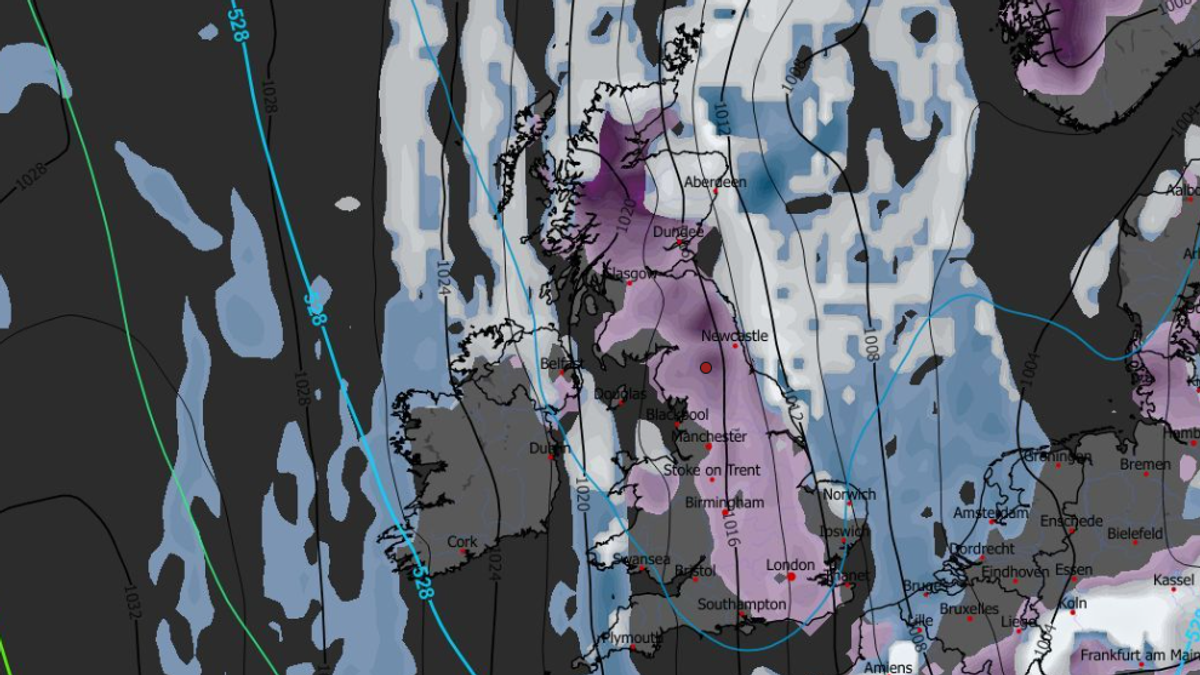

As the UK prepares for heavy snowfall this week, meteorologists are warning of prolonged cold weather due to the recurrence of the weather pattern responsible for the 2018 ‘Beast from the East’.
The UK’s Met Office has issued multiple yellow weather alerts for snow and ice from today until Thursday. Additionally, an amber snow warning is in effect on Thursday for areas in Yorkshire and the North East, where up to 25cm (10 inches) of snow may accumulate.
Further wintry disruptions could be on the horizon as experts predict the possible occurrence of sudden stratospheric warming (SSW), reminiscent of the infamous ‘Beast from the East’ snowstorm in 2018.
Contrary to its name, SSW can bring bitterly cold temperatures and Arctic-like conditions to the UK. During the cold spell in 2018, certain regions experienced up to 20 inches of snowfall.
Met Office spokesperson Stephen Dixon indicated that indicators point towards a potential SSW event towards the end of November, which would be unusually early in the season. Dixon remarked, “While such events occasionally occur in November, it is relatively premature in the winter season. This raises the likelihood of a cold start to the winter compared to recent years.”
Weather expert Nick Finnis from Netweather suggested that SSW might manifest around November 25 and 26, triggered by a significant stratospheric warming event originating from the Canadian polar region, potentially displacing the stratospheric polar vortex towards northern Russia and north-east Europe.
There is no definitive indication yet that this year’s SSW event will result in conditions similar to those of 2018. Dixon cautioned, “It is premature to determine the exact impact on the UK at this stage.”
Finnis suggested, “The UK could face increased chances of more cold and possibly wintry conditions as we approach the end of the month and move into December if the SSW occurs.” However, he added that “there are no guarantees of cold weather due to an SSW.”
The Met Office defines SSW as a rapid stratospheric warming, up to approximately 50C in just a few days, occurring between 10km and 50km above the earth’s surface.
This phenomenon results from changes in the polar vortex, leading to the descent of cold air, influencing the jet stream and potentially creating a blocking pattern that can prolong snowfall and cold conditions.
Opt for Daily Mirror as your ‘Preferred Source’ on Google News for immediate access to the news content you value.
At Reach and across our entities we and our partners use information collected through cookies and other identifiers from your device to improve experience on our site, analyse how it is used and to show personalised advertising. You can opt out of the sale or sharing of your data, at any time clicking the “Do Not Sell or Share my Data” button at the bottom