

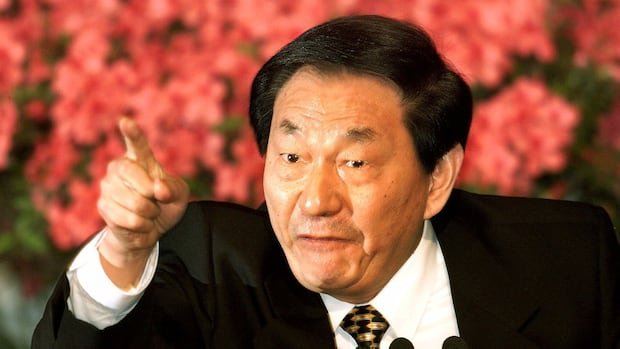

Former Chinese premier Zhu Rongji has passed away at the age of 97, as reported by state media. The official Xinhua news agency announced his death in Beijing around 11 a.m. on Wednesday due to illness. Zhu, known for his impatience and sharp-tongued approach, played a significant role in driving China’s remarkable economic growth by implementing major reforms in the 1990s and leading the country’s entry into the World Trade Organization.
Initially faced with exile to rural areas for advocating reforms in other communist nations, Zhu spearheaded a series of transformative measures during his tenure as premier from 1998 to 2003. Despite facing resistance from Communist Party traditionalists and state-owned enterprise leaders, Zhu championed the drive for state-owned companies to enhance efficiency and profitability, resulting in millions of job cuts but ultimately propelling China to become the world’s second-largest economy after the United States in 2010.
Expanding on Deng Xiaoping’s economic reforms from 1979, Zhu is lauded for his instrumental role in steering China towards WTO membership, a move that facilitated the country’s evolution into a global export powerhouse. These initiatives contributed to sustaining economic growth above eight percent annually from 2000 to 2010, reaching a peak of 14.2 percent in 2007.
Assuming the premiership at 69 years old in 1998, Zhu garnered widespread popularity through his outspoken criticism of administrative failures and corruption, often taking personal responsibility for governmental shortcomings. His no-nonsense leadership style earned him monikers like “Boss” and “Madman Zhu,” with his memorable quote in 1998 stating, “I have prepared 100 coffins here — 99 for corrupt officials and one for myself,” as reported by the People’s Daily.
Ranked third in the party hierarchy behind President Jiang Zemin and National People’s Congress chairman Li Peng, Zhu’s early achievements as deputy premier in the 1990s included curbing inflation by enforcing price controls and halting loans to unprofitable state enterprises, despite facing opposition from local authorities. He later spearheaded the arduous negotiations for China’s WTO accession, using this milestone to dismantle protectionist practices at local levels.
In 1998, Zhu kickstarted China’s housing market boom by initiating the sale of state-owned company apartments, leading to a surge in private homeownership within urban areas over the subsequent decade. Notably, Zhu advocated for the corporatization of key sectors like banking and airlines while maintaining state ownership, rejecting full privatization.
Born in Hunan province on October 23, 1928, Zhu’s early advocacy for reforms in the late 1950s resulted in a prolonged political exile during the Cultural Revolution. Following his rehabilitation in 1979, Zhu’s rapid ascent in the political ranks showcased his adept governance skills, including defusing tensions during the 1989 protests in Shanghai.
Throughout his tenure, Zhu displayed a willingness to acknowledge official errors and assume accountability, a departure from the party’s conventional stance of infallibility. His candid approach, coupled with a penchant for humor in public addresses, endeared him to the populace. Additionally, Zhu’s tax reform initiatives aimed at centralizing revenue collection in Beijing were hailed as groundbreaking, with Zhu humorously remarking in 1996 that he deserved a Nobel Prize in economics for his efforts.