

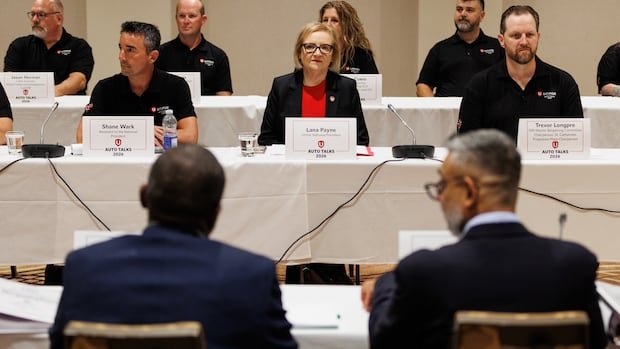

Unifor and General Motors have initiated discussions for a new labor agreement, commencing negotiations at a bargaining table in downtown Toronto on Monday. The union represents over 4,600 members across various Ontario GM facilities, including the Oshawa assembly plant, the CAMI facility in Ingersoll, and operations in St. Catharines and Woodstock.
Lana Payne, Unifor’s national president, and Jack Uppal, president and managing director at GM Canada, officially started the talks by shaking hands. The negotiating table was set with chairs, with Payne positioned in the center and Uppal seated directly across from her.
In a statement released on Monday, Payne expressed determination to engage in meaningful conversations regarding GM’s operations and the future of auto jobs in Canada, building upon the foundation set by the pattern agreement with Ford. Unifor has set a deadline of August 21 to reach a tentative agreement with GM.
Uppal, in a separate news release, emphasized the company’s deep respect for the collective bargaining process and the crucial role played by its employees in its success. He highlighted GM’s significant investments in Canadian manufacturing plants since 2020, aiming to secure long-term jobs and competitiveness for GM Canada.
Previously, Unifor members approved a new three-year contract with Ford in July, featuring annual pay increases and program commitments across Ford facilities. The agreement also included initiatives like a third shift at the engine plant in Essex, Ont., slated for 2029.
Unifor and Ford further agreed on a program to facilitate laid-off workers from Ford’s Oakville assembly plant towards full employment by July 2027. The union hailed this agreement as a successful model for negotiations, following the pattern bargaining strategy.
While the agreement with Ford was viewed positively, Payne acknowledged potential complexities in negotiations with other automakers like General Motors and Stellantis. Challenges such as plant closures and trade uncertainties pose additional hurdles in the current bargaining landscape for Unifor and the Detroit Three automakers.
These negotiations occur amid industry challenges including U.S. tariffs, trade agreements, and the entry of Chinese electric vehicles into the Canadian market, adding further pressure to secure competitive terms for auto workers in Canada.