

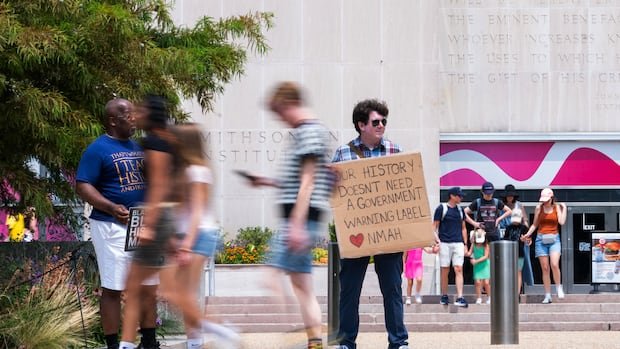

The National Museum of American History in Washington, D.C., attracts visitors from around the globe who come to view iconic artifacts such as Dorothy’s ruby slippers from the movie “Wizard of Oz,” the first ladies’ inaugural gowns, and the historic flag that inspired the national anthem. However, the museum has recently become a focal point of controversy as protesters gather outside, holding signs advocating for truth and challenging traditional narratives.
Experts suggest that the current administration’s actions are part of a broader agenda to influence the storytelling within cultural institutions, aligning exhibits with conservative values and diminishing the influence of independent experts. President Trump’s directive to post signs cautioning visitors about alleged inaccuracies in the museum’s displays is seen as a move to reshape historical narratives.
Despite not yet being displayed, these signs are intended to direct visitors to a detailed 162-page White House report released on America’s 250th anniversary. The report accuses the Smithsonian’s leadership of political activism and prioritizing divisive narratives over celebratory and patriotic ones. Trump’s previous criticism of the Smithsonian’s focus on negative aspects of American history, such as slavery, has further fueled the ongoing scrutiny of the museum’s content.
In response, the Smithsonian has defended its commitment to scholarly accuracy and presenting a comprehensive view of America’s story. The institution’s leadership has emphasized the importance of curatorial independence and scholarly integrity in the face of external pressures. The museum’s steadfast defense of its work has garnered praise from supporters who view it as a beacon of historical accuracy and integrity.
The recent scrutiny of the Smithsonian’s exhibits and programs is perceived by some as a prelude to potential changes in the institution’s leadership. Concerns have been raised about attempts to influence the museum’s direction and narrative by appointing sympathetic board members. Critics argue that such efforts could be driven by political motives rather than a genuine concern for historical accuracy and inclusivity.
As the Smithsonian navigates these challenges, public opinion remains divided on the issue of political interference in museum content. Polling data indicates varying levels of support for curatorial independence across different political affiliations. While some visitors express discontent with perceived ideological biases in museum displays, others appreciate the diversity of perspectives presented in showcasing American history.
Despite the ongoing debate surrounding the Smithsonian’s direction, the institution continues to be a trusted source of historical information and cultural preservation. With a rich legacy spanning nearly two centuries, the Smithsonian remains a vital repository of American heritage, attracting diverse audiences seeking to engage with the nation’s multifaceted history.