

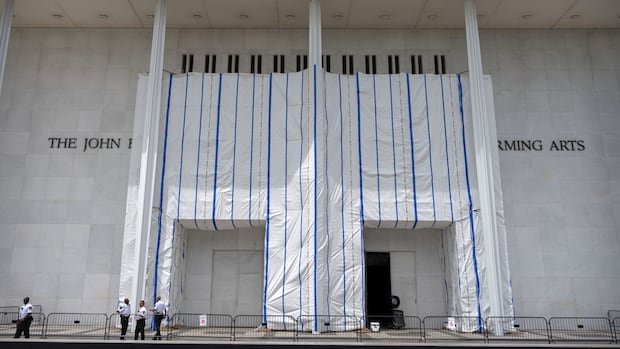

The debate surrounding the future of the Kennedy Center intensified on Thursday as allies of U.S. President Donald Trump on the board advanced efforts to honor him through physical alterations to the renowned arts venue that may defy a federal court ruling.
In a lengthy virtual meeting, the board decided to incorporate Trump’s name onto the building’s facade, rebranding it as “The John F. Kennedy Center for the Performing Arts Restored and Renovated By President Donald J. Trump.” Additionally, they proposed naming the plaza in front of the center after Trump and initiating a two-year closure to facilitate significant renovations.
These actions, as described by Representative Joyce Beatty, a Democratic board member, and her legal team, represent a significant challenge to U.S. District Judge Christopher Cooper’s authority. Judge Cooper previously ruled that the unauthorized addition of Trump’s name to the building was unlawful and ordered its removal, a decision that the administration unsuccessfully attempted to reverse. He also blocked the planned two-year closure, citing concerns over the board’s decision-making process.
Beatty criticized these recent developments as an attempt to circumvent the court’s ruling and violate congressional statutes. She vowed to continue advocating for the preservation of the historic monument. The Kennedy Center declined to comment immediately on these latest developments.
Much of the board meeting revolved around discussions on the necessary closures for safety-focused renovations. In response to criticisms from the judge, the center’s leadership presented three closure options for board consideration: a complete closure, a partial closure with limited public access, or a phased closure to address critical infrastructure needs while maintaining programming.
Ultimately, the board opted for a two-year closure while leaving the possibility of some programming in the outdoor Reach space. This decision, coupled with the efforts to commemorate Trump, raises questions about the thoroughness of the board’s deliberations on available alternatives.
Trump’s tenure has seen a significant transformation of the Kennedy Center, symbolizing his influence in Washington. Following his return to office, he swiftly replaced the institution’s leadership, assumed the role of board chairman, and had his name temporarily displayed on the building before its removal per court orders. This move aligns with Trump’s broader agenda of reshaping Washington, evident in projects such as the White House East Wing demolition and the contentious ballroom construction.
The Kennedy Center leadership has emphasized the urgent need for repairs and updates within the facility. Executive Director Matt Floca highlighted severe water damage and outdated equipment during a guided tour, advocating for a comprehensive renovation approach.
As legal battles persist, the Kennedy Center’s future remains uncertain amid ongoing debates and efforts to balance preservation with modernization. The institution’s significance as a cultural hub and artistic landmark continues to be a point of contention amid the push for renovations and commemorations linked to the Trump administration.