

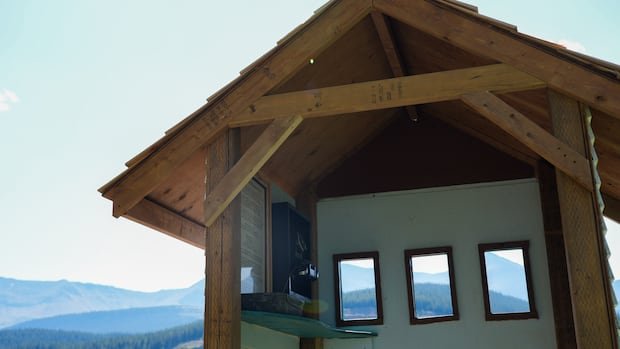

Andy McCracken, a septuagenarian, takes a moment before dialing his father’s previous number on an old rotary telephone on a sunny day towards the end of July. Speaking into the inactive landline within a small wooden structure next to a cemetery in Alberta’s Rocky Mountain foothills, he engages with what is known as a “wind phone” – a symbolic device connecting the living with the deceased, enabling visitors to have one-sided conversations with departed loved ones.
Perched above the valley of a former coal mining town, now reclaimed by nature and transformed into a ghost town, McCracken stands at Mountain Park Cemetery in Yellowhead County, the highest-altitude cemetery in Canada. The locale is now home to North America’s highest wind phone, situated at nearly 1,900 meters above sea level, installed by Yellowhead County at the conclusion of July.
When the time arrives for Andy McCracken and his wife Anne McCracken to be interred, their ashes will find a final resting place at Mountain Park. Hailing from Edson, Alta., the couple is eligible for burial there due to Andy’s origins in a Coal Branch town, where his father served as the mine doctor.
Expressing gratitude to his father through the wind phone, Andy McCracken says, “I just want to thank you for delivering me in Luscar, Alta., in 1953 and to be able to keep us enjoying the mountains. Lots of love Daddo, thank you, bye – and say hello to Mum.”
Established in 1911 as the terminus of the Grand Trunk Pacific Railway line, Mountain Park was active until 1950 when the coal mine ceased operations permanently. At its peak, the community housed around 1,000 residents in 100 homes. Today, only the cemetery remains, containing 269 recorded burials dating back to 1913.
During an interview with CBC News at the cemetery, Madison Sharman, heritage co-ordinator for Yellowhead County, pointed out a faint “Y” shape, now covered in greenery, denoting the former train tracks’ split. In the absence of road access during the mine’s operation, the train served as the town’s sole link to the outside world.
Engaging in activities within the remote wilderness, residents created their own entertainment: men raced up nearby Mount Baldy, and on weekends, young locals journeyed an hour and a half down the train tracks to Cadomin for community dances.
Despite the romanticized notion of a secluded life in the subalpine region, Mountain Park Cemetery’s history reflects frontier hardships. Notably, the cemetery includes infant burial sites, serving as a poignant reminder of the challenges faced by early residents.
Tragedies such as the Spanish flu pandemic in the late 1910s and mining accidents resulted in numerous deaths in the community. The cemetery stands as a testament to the struggles and sacrifices of those who once called Mountain Park home.
In an effort to preserve the cemetery’s heritage, volunteers, including former residents like the McCrackens, dedicated their time to restoration projects. Today, the cemetery is maintained by Yellowhead County, honoring the memory of those interred there while accommodating new cremation burials for local individuals.
Among the notable figures laid to rest at Mountain Park is John Mitchell, recognized as a Knight of the National Order of the Legion of Honour for his service during D-Day. The cemetery continues to welcome visitors, celebrating the lives of its residents and preserving their legacies.
The wind phone booth at Mountain Park features a poem penned by Madison Sharman, emphasizing the enduring nature of love and memories, highlighting how every story shared into the wind becomes a part of the landscape once more.