

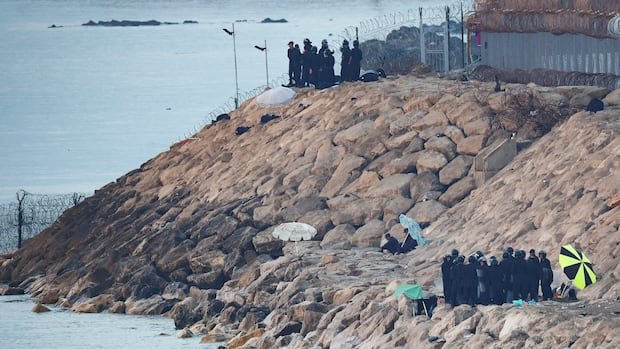

Moroccan authorities apprehended over 111 individuals on Saturday as they attempted to enter the Spanish enclave of Ceuta in North Africa. This incident occurred amidst heightened security measures on both sides of the border following social media calls for another large-scale migrant crossing.
The attempted crossing happened following a previous influx of more than 72,000 migrants into Ceuta, which had caused tensions within the European Union and fueled anti-immigration sentiments among far-right groups globally. Tragically, at least 96 people lost their lives while trying to reach European territory.
A source from Morocco’s Interior Ministry informed Reuters that the detained individuals included 109 migrants from sub-Saharan Africa and two Moroccan citizens apprehended in or near Fnideq, the city in Morocco opposite Ceuta. Reports from Spanish news agency EFE indicated that Moroccan police utilized tear gas to disperse migrant groups gathered on hills approximately three kilometers from the border. Subsequently, hundreds of police officers were observed, some in riot gear and others in plain clothes, returning from the outskirts of Fnideq.
In Ceuta, Spanish soldiers were stationed at supermarkets while police maintained a heavy presence on the main streets of the enclave. The city appeared calmer compared to the days following the previous crossing attempt at the end of July.
To address the situation, Madrid implemented a maritime barrier and deployed over 500 additional police officers from mainland Spain, increasing the total presence in Ceuta to more than 1,600. The Interior Ministry emphasized that these reinforcements would remain as long as necessary to restore normalcy and prevent similar incidents from reoccurring.
Interior Minister Fernando Grande-Marlaska stated that migrants entering irregularly would not be permitted to stay in Ceuta, travel to mainland Spain, or obtain legal status, with exceptions made for cases of extreme vulnerability. Those lacking the right to stay would be repatriated to Morocco.
Recent reports indicated heightened security near the border, including police vans with wire shields and road checkpoints. Measures were also reported near Spain’s other North African enclave, Melilla. Authorities took steps to prevent groups from boarding transportation to northern Morocco in cities such as Casablanca, Fez, and Kenitra.
Despite these efforts, witnesses noted that some sub-Saharan African migrants were circumventing security checkpoints by taking mountain routes toward Fnideq. Additionally, schools in Fnideq were reportedly repurposed as accommodation for security forces near the border.
In a plea for caution, a young man named Driss Sadik, who had swum for five hours to reach Ceuta, advised against attempting the crossing. He warned, “Don’t cross now, my brothers. You’re only going to suffer.” Another individual, Adil Jamil, echoed this sentiment, emphasizing that the influx of migrants would not lead to beneficial outcomes and urging others to reconsider their decisions.
The mass border crossings were described as organized events, with participants selecting dates, congregating in Fnideq, and crossing in groups to amplify their collective strength and chances of success.