

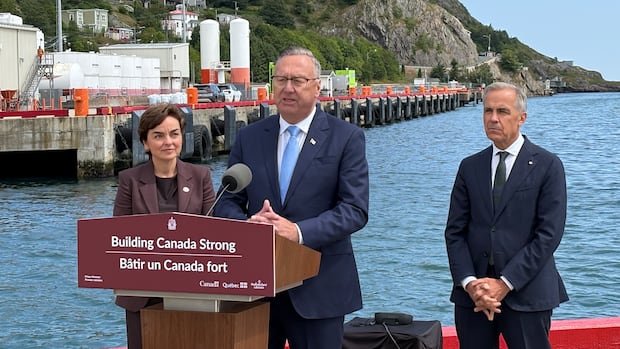

Ottawa has declared it as the most extensive clean energy investment in North American history. Prime Minister Mark Carney, accompanied by N.L. Premier Tony Wakeham and Quebec Premier Christine Fréchette, made the announcement in St. John’s on Monday regarding a new agreement on Churchill Falls and other electricity projects in Labrador.
Wakeham stated, “We are finally turning the page on one of the darkest chapters in our past, and replacing both the notorious 1969 Churchill Falls agreement and the 2024 MOU with a better deal for all of us.” The leaders convened on Pier 17 against a stunning ocean backdrop to unveil the details of the new deal.
The agreement entails $10 billion in federal funding for the enhancement and expansion of the Churchill Falls generating station, the development of the Gull Island hydroelectric project, the construction of transmission lines, and the implementation of a 2,000 MW onshore wind energy project in Labrador. These projects, collectively valued at nearly $70 billion, represent the most substantial clean energy investment in North American history. They will almost triple the current generating capacity of Churchill Falls, providing enough power to illuminate, warm, and cool all the residences in Toronto, Montreal, and Vancouver combined.
The federal government estimates that these projects will create job opportunities for 23,000 individuals. Wakeham referred to the agreement as a “win-win-win,” signifying an advantageous outcome for all parties involved. The new agreement between Newfoundland and Labrador Hydro and Hydro-Quebec is set to enhance N.L.’s value from the previously estimated $36 billion in the 2024 MOU to $49 billion in net present value.
The agreement, scheduled to be signed on Monday, includes upgrades to the existing Churchill Falls facility, increasing its capacity by 23.5 percent or 1,275 MW. Additionally, there will be a focus on exploring the potential expansion of Churchill Falls and the development of a new wind project generating facility. These initiatives aim to provide Newfoundland and Labrador with approximately 760 MW more power, potentially rising to 2,750 MW with the completion of the wind project. Meanwhile, Hydro-Quebec will have access to up to 6,915 MW, or up to 8,515 MW if the wind project is finalized.
The additional power generated from these projects is expected to support the growth of Labrador’s mining sector. Ottawa is allocating over $2.3 million for an engineering and design study on transmission lines to supply more power to Labrador west, as well as $439,844 for preconstruction and feasibility planning for the Kami iron ore project southwest of Wabush.