

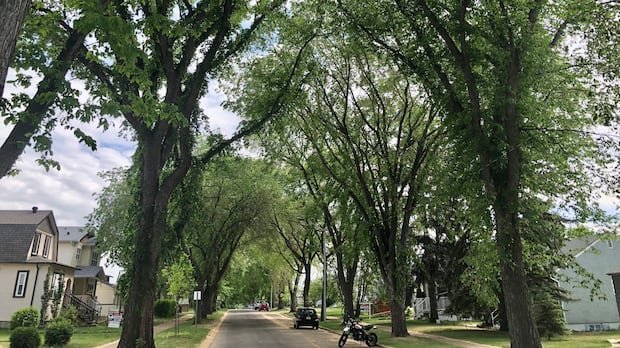

A specialist in forest health has expressed concerns regarding the City of Edmonton’s strategy in combatting Dutch elm disease, warning of potential long-lasting impacts on the city’s tree cover. Since 2024, Edmonton has recorded 16 cases of Dutch elm disease, with nine of them identified this year. Approximately 22% of the city’s tree canopy consists of elm trees, predominantly American elms known for their tall, upright stature and sprawling canopy, making them a popular choice for urban landscapes.
Dutch elm disease is caused by a fungus carried by bark beetles, which obstructs the tree’s water-conducting ability, leading to wilting and eventual death. Presently, Edmonton’s focus lies on removing infected trees, with healthy elm trees within a 20-meter radius of infected ones also being taken down as a preventive measure. However, according to Nadir Erbilgin, a forest health professor at the University of Alberta, this approach may not be optimal. Erbilgin suggests the introduction of trap trees to target the disease at its source—the bark beetles.
The trap tree method involves attracting disease-carrying beetles to designated trees to reduce their population and curb the spread of the disease. Erbilgin argues that the current removal approach adopted by many cities in North America risks the loss of more healthy trees than the disease itself, potentially including resistant ones. Mike Jenkins, a senior scientist with the City of Edmonton, acknowledged that the current strategy has led to the removal of healthy trees, including mature elm trees in areas like Rossdale.
Jenkins emphasized the city’s enhanced surveillance efforts to detect the disease early, preventing further spread. City crews inspect all city and private elm trees at least once a year, increasing to monthly checks in detection zones. The city plans to integrate trap trees into its approach next year, focusing on Siberian elms, which are often found on private properties.
Jenkins noted that Siberian elms are typically resistant to Dutch elm disease but can harbor beetles that spread the disease to American elms. To mitigate this, the city intends to prune deadwood from Siberian elms during the upcoming fall dormant season. As the city continues its battle against Dutch elm disease, residents are urged to participate by maintaining their elm trees regularly and scheduling periodic inspections. Pruning of elm trees is prohibited between April 1 and September 30 in Edmonton, with full-scale removal permitted during this period, provided the wood isn’t stored. Residents can dispose of elm wood at the Edmonton Waste Management Centre and must report any trees suspected of having Dutch elm disease to the city.