

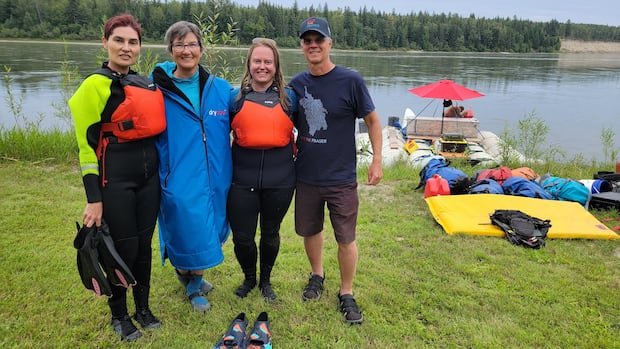

A forest disturbance ecologist from Prince George, B.C., Michelle Connolly dedicates her time to safeguarding forest ecosystems from industrial activities. Recently, she has joined a relay team swimming the entire 1,375-kilometre length of the Fraser River to raise awareness about preserving the Fraser rivershed. The swim, organized by the Fraser Riverkeeper Society, aims to highlight the significance of the river, known as one of the world’s prime salmon-bearing rivers and a major wild waterway.
Connolly, typically accustomed to land work, now gains a fresh perspective on the river’s protection efforts by immersing herself in the Fraser daily. She emphasizes the unique insights gained from experiencing the river firsthand, referring to it as the lifeblood of British Columbia.
The relay team consists of core members Naomi Devine and Isabelle Côté, alongside swimmers from local First Nations. The expedition traces the path taken by Fin Donnelly during his swims in 1995 and 2000. Donnelly, the leader of the Fraser Riverkeeper Society, is actively involved in supporting the current swim to safeguard 30% of the Fraser rivershed by 2030.
Amid the ongoing campaign to increase conservation efforts, Donnelly stresses the importance of collaboration with rights and title holders across the Fraser rivershed. With only 17.6% of the rivershed currently protected, the society underscores the urgent need for conservation measures due to habitat fragmentation caused by industrial expansion.
The relay swimmers commenced their journey from Tête Jaune Cache on August 7, averaging approximately 40 kilometers per day with crew support on rafts and a dinghy. Despite encountering challenges like cold waters and rough terrains, the team remains determined to complete their mission, aiming to exit the Fraser River at Garry Point Park in Richmond on September 4.
The Fraser River holds critical ecological, cultural, and economic value, supporting various ecosystems and communities. However, with declining salmon populations and environmental stressors like climate change-induced challenges, the river faces a crucial juncture. The ongoing swim serves as a symbolic gesture to rally support for the conservation and protection of this vital waterway.