

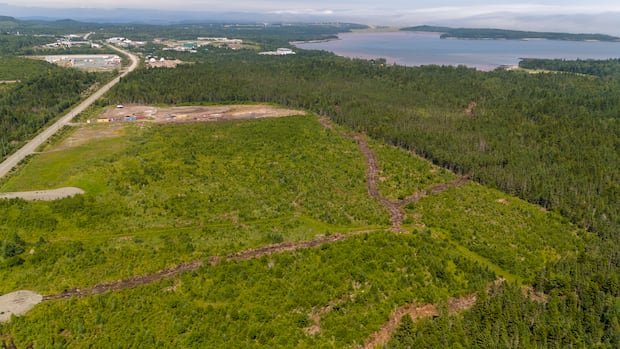

Residents from the rural community of Lorneville in Saint John made arguments in court on Tuesday challenging the city council’s decision to approve an expansion of the Spruce Lake Industrial Park. Adam Wilkins, Shayne Galbraith, and Chris Watson represented the community’s concerns before Justice Kathryn Gregory at the Court of King’s Bench. The city is set to present its response to the residents on Wednesday.
The legal proceedings mark the latest development in a story that began over two years ago when the city unveiled plans to designate over 600 hectares for industrial development. The rezoning and land designation changes were officially sanctioned in July 2025.
During the court session, Chris Watson emphasized the community’s request to nullify the decision and revised bylaws, urging a fresh review by the common council, including a new public hearing, as per the court’s directive. Wilkins, Galbraith, and Watson initiated the judicial review request last October, contending that the council’s approval was predetermined and lacked impartial consideration.
The rezoning, which permitted certain heavy industrial activities, was unanimously endorsed by the council despite objections from Lorneville residents and other Saint John locals. Prior to the council’s decision last summer, over 70 individuals voiced concerns about potential impacts on water wells, wetlands, forests, air quality, and overall quality of life during a public hearing.
An American company, Volta Grid, is now proposing to establish a data center at the newly zoned site, facing opposition from the community and undergoing environmental scrutiny by provincial authorities.
Residents raised questions about the fairness of the council’s procedures during the court hearing, challenging the council’s openness to alternative viewpoints and the rationale behind the zoning alterations. They cited Supreme Court precedents on procedural fairness and reasonableness in their arguments.
Chris Watson highlighted that municipal councilors, as elected officials, should be open to persuasion and consider objections before reaching final decisions. Residents referenced public statements made by the mayor and former council members in various forums to support their case.
Acknowledging the city’s efforts to engage residents through a liaison committee and project modifications, residents questioned the reasonableness of the industrial park expansion based on municipal plan policies. They critiqued the lack of clarity in the staff report regarding the necessity to change land designations and the adequacy of environmental impact assessments.
Residents disputed the city’s reliance on the environmental impact assessment as the sole justification for the land redesignation. The ongoing legal battle reflects the community’s steadfast efforts to challenge the council’s decision-making process and safeguard the interests of Lorneville residents.