

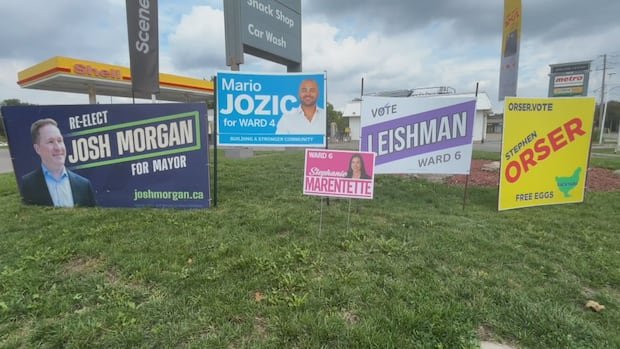

London’s mayoral race features incumbent Josh Morgan along with contenders Susan Stevenson, Kirsten Krose, and John Feher. However, these names are not for voters to mark an ‘X’ on a ballot. Instead, they serve as options for bettors looking to wager on the next mayor of London, with over $6,000 already in play.
These betting opportunities are available on Polymarket.com, a U.S.-based prediction-market platform. Such sites offer bets on various outcomes, ranging from the price movement of Bitcoin to predictions on celebrity relationships.
Prediction markets enable users to bet on binary outcomes, such as yes or no propositions. In addition to London, Polymarket offers odds on the next mayor in other Ontario cities like Windsor, Toronto, and Stratford.
Unlike traditional sports betting websites, Polymarket operates differently. Users do not bet against a house or bookmaker but rather against other users supporting the opposite outcome. Bet odds are expressed as shares of each contract, with prices ranging from one cent to one dollar, representing the approximate payout minus a handling fee.
For instance, a contract predicting Josh Morgan’s re-election costs 64 cents, with a potential payout of about a dollar. Conversely, a contract wagering on Susan Stevenson’s victory would cost 15 cents. Bets can be scaled up, with a $1,000 winning contract for Morgan’s re-election priced at $640.
Additionally, prediction market contracts can be traded before the event concludes, with prices determined by market demand. In Canada, regulators have permitted limited prediction-market trading on economic indicators, financial markets, and climate trends, but not on sports, elections, or pop culture.
While Canadians cannot directly access Polymarket, some use VPNs to bypass restrictions. The platform offers odds on various mayoral races due to its user base in jurisdictions where such bets are not regulated.
Brock University finance professor Ernest Biktimirov supports Canada’s ban on election betting in prediction markets, citing concerns about insider trading and market manipulation. He warns that small markets, like local elections, are vulnerable to price manipulation by individuals with significant funds.
Notably, prediction markets can influence voter behavior, with some perceiving posted odds as indicative of candidate support levels. Political science professor Noah Vanderhoeven from Western University suggests that significant bets on a particular position could sway voters’ decisions.
Ontario municipal elections, including London’s, are scheduled for October 26.