

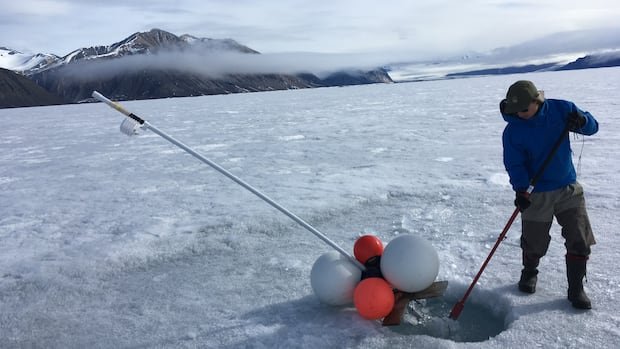

Canada’s last remaining epishelf lake, characterized by freshwater floating on saltwater, has vanished, leading to the loss of its unique ecosystem, as per a recent study by scientists. Jérémie Bonneau, an assistant professor at Laval University in Quebec City and the study’s lead author, expressed sorrow over the disappearance of the Milne Fiord epishelf lake on Ellesmere Island in Nunavut, emphasizing its significance as “the last thing like that in Canada.” The sudden drainage of the lake resulted in the extinction of all life forms residing within it.
This event underscores the impact of a warming climate on the Arctic, showcasing a significant transformation. While previous reports had indicated the disappearance of the lake, the newly published study in the journal Scientific Reports elaborates on the process and highlights the irreversible nature of the loss, marking the end of a 4000-year era.
Epishelf lakes are a unique phenomenon where freshwater accumulates on top of saltwater due to natural barriers. The Milne Fiord lake had maintained this delicate balance for millennia until the collapse of the Milne Ice Shelf in 2020, which led to the lake’s ultimate demise. The lake’s biodiversity, characterized by distinct ecosystems in the freshwater and saltwater layers, has now been lost forever.
The study also revealed the profound impact of the lake beyond its boundaries, with nutrients from the lake supporting a diverse ecosystem below the ice surface. The disappearance of the lake has not only disrupted the local environment but also serves as a stark reminder of the irreversible changes occurring in our planet due to climate change.
While epishelf lakes have vanished from Canada, a few still exist in Greenland and Antarctica. However, experts warn that these ecosystems are also at risk, emphasizing the urgent need for conservation efforts to protect these unique natural wonders before they too disappear.