

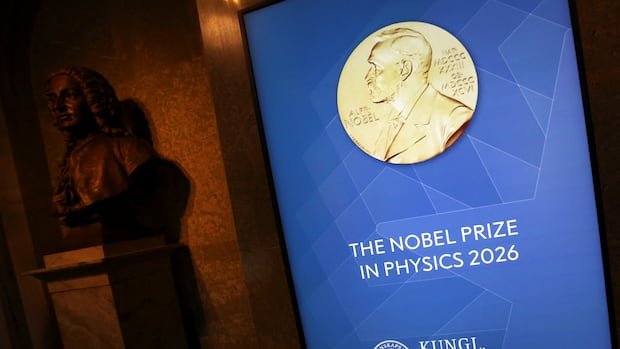

Belgian American physicist Francis Halzen, 82, has been named the recipient of the 2026 Nobel Prize in Physics in Stockholm. The award recognized Halzen’s significant contributions to the IceCube Neutrino Observatory and the detection of high-energy neutrinos from astrophysical sources. Situated at the Amundsen–Scott South Pole Station in Antarctica, the observatory was a key factor in his achievement.
The Royal Swedish Academy of Sciences annually selects the winners of the Nobel Prize in Physics, with a total prize sum of 12 million Swedish crowns ($1.7 million Cdn) awarded to the recipients. Halzen’s groundbreaking vision for capturing neutrinos at the South Pole dates back to 1988, as explained by the academy. Neutrinos, when colliding with atomic nuclei, generate a light flash detectable by sensors embedded in the clear glacial ice.
The IceCube Observatory, spanning an entire cubic kilometer, became operational in 2011. Halzen, a long-time affiliate of the University of Wisconsin–Madison, expressed his joy and surprise at the announcement while attending a conference in Italy.
Neutrinos, minuscule cosmic particles with incredibly small masses, are prevalent in the universe. These elusive particles emanate from celestial bodies like the sun, with trillions passing through our bodies each second. Scientists study neutrinos by observing their interactions with matter, leading to the emission of light or charged particles.
Halzen’s research focused on a unique group of neutrinos believed to convey messages from the cosmos, shedding light on the universe’s evolution. In 2015, the Swedish academy acknowledged the discovery of neutrino oscillations, with Canadian scientist Dr. Neil McDonald sharing the Nobel Prize in Physics that year.
The Nobel Prize in Chemistry will be unveiled on Wednesday, followed by the literature prize on Thursday and the peace prize on Friday. The economics prize announcement is scheduled for October 12.
Established by Alfred Nobel, a Swedish chemist, and entrepreneur, the Nobel Prize aims to reward individuals who have made significant contributions benefiting humanity. Nobel, renowned for inventing dynamite, possessed diverse talents, including proficiency in several languages and a passion for literature. The prizes are traditionally presented to laureates on December 10, commemorating Nobel’s passing.