

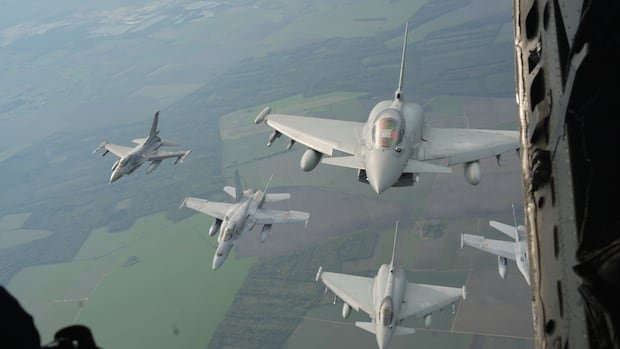

During the recent national election in Latvia, unbeknownst to many voters, fighter jets from Turkey, Spain, and Italy were on patrol in the skies above, tasked with monitoring any potential Russian interference. Capt. Antonio Moncebo, a Spanish F-18 pilot stationed in Estonia, emphasized the strict control over alliance airspace, stating that any unauthorized aircraft would be intercepted and neutralized promptly.
NATO’s surveillance efforts, known as the “sky shield,” have evolved beyond routine exercises. While some military strategists within NATO believe Russia is unlikely to initiate a war with the alliance, there are concerns that President Vladimir Putin might employ lower-level provocations to test NATO’s response, particularly in the vulnerable Baltic states.
Instances such as suspected Russian arson attacks in Estonia and thwarted terrorist plots in Germany demonstrate Russia’s willingness to challenge Western resolve. Justin Bronk of the British military think-tank RUSI highlighted the potential exploitation of tensions between U.S. President Donald Trump and Europe by Putin to undermine NATO’s unity.
NATO’s readiness to counter possible Russian aggression is a critical issue. Lieut.-Gen. Guillaume Thomas, overseeing air operations in the Baltic region, expressed confidence in U.S. support and emphasized the continuous development of U.S. forces to safeguard the alliance.
To showcase its preparedness, NATO recently hosted a select group of media personnel to witness firsthand the air defense operations over the Baltic states. This demonstration involved a close-up view of various fighter jets in action, symbolizing NATO’s enhanced focus on securing its eastern flank.
While NATO’s efforts are commendable, the threat posed by Russian drones remains a challenge. Baltic countries like Latvia are investing in advanced defense systems, such as a “drone wall,” to detect and intercept hostile drones along their borders. New anti-drone technologies, like the Latvian-designed Blaze system, are being introduced to counter this evolving threat.
Canada plays a crucial role in ensuring the defense of NATO’s vulnerable areas, with up to 3,000 Canadian troops stationed near Russia’s borders. Canadian Brig.-Gen. Mason Stalker emphasized the importance of combat readiness to fulfill NATO obligations, highlighting the flexibility and strength of the multinational forces.
For Latvians, the historical memory of Soviet occupation and ongoing tensions with Russia create a sense of unease. While some express concerns about a potential resurgence of conflict, others find reassurance in NATO and Canadian military presence, believing it provides a sense of security that was lacking in the past.