

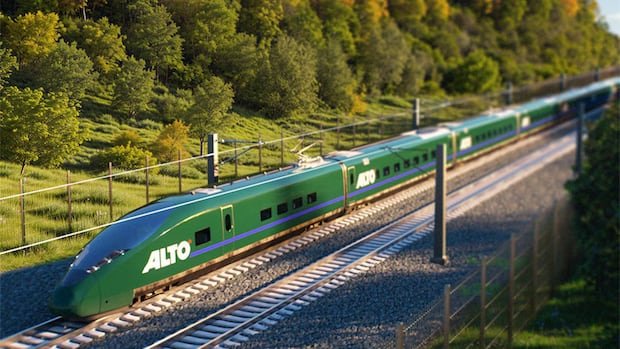

The government-owned organization overseeing a proposed high-speed train linking Toronto to Quebec City has reaffirmed its commitment to the project despite opposition from the newly elected Parti Québécois (PQ) administration.
During the election campaign, the PQ vowed to halt Alto’s planned train initiative if it assumed power. PQ Leader Paul St-Pierre Plamondon contends that the funds allocated for the project should be redirected to maintain the province’s deteriorating infrastructure, including hospitals, roads, and public transportation.
A recent report from the Parliamentary Budget Office indicates that constructing the proposed high-speed rail system could cost between $75 billion and $113 billion, surpassing the initial estimates. St-Pierre Plamondon argues that if there are billions of dollars available for infrastructure investment, the high-speed rail project is not a top priority for Quebec residents.
In a public meeting, Alto confirmed that the project, from conception to completion, is expected to span approximately 15 years, involving collaboration with multiple governments. The aim is to commence construction by 2029.
Alto’s board chairman, J. Robert S. Prichard, emphasized the organization’s focus on project readiness and timely delivery within budget constraints, leaving governmental relations to the respective authorities.
Responding to the PQ’s opposition, the office of federal Transport Minister Steven MacKinnon expressed the Canadian government’s commitment to collaborative federalism and readiness to engage with the Quebec government on the initiative.
A professor at the University of Ottawa’s school of political studies, André Lecours, believes the project’s feasibility hinges on Quebec government support. He opined that proceeding against the PQ’s wishes would not be in the federal government’s best interest, given the need to minimize tensions with Quebec.
The Conservative Party of Quebec, which secured a historic 19 seats in the recent election, has also voiced reservations about the project. Agricultural groups, such as the Fédération de l’UPA de la Montérégie, have raised concerns about the detrimental impact on farming communities in both provinces.
Alto’s CEO, Martin Imbleau, sought to allay fears among farmers, assuring that major highways would remain intact, even as a detailed route for the Ottawa-Montreal section of the network is anticipated in the fall. Construction of the initial train segment is slated to commence in 2029.