

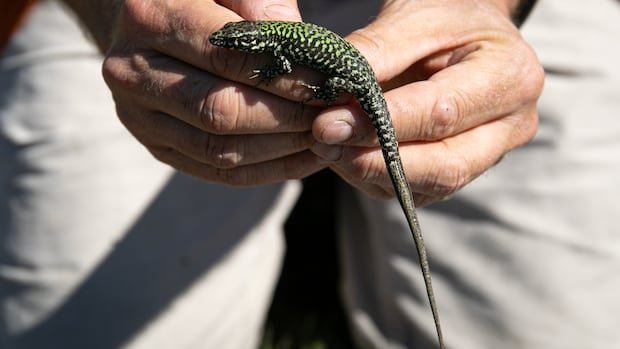

Tracy Menzies had been struggling with slugs in her backyard garden, as they consistently outpaced her to the harvest, until this year. The strawberries in her garden have turned out to be exceptionally beautiful this season.
It appears that the slugs are encountering a formidable adversary — the invasive European wall lizard, which experts indicate are rapidly proliferating and consuming a wide range of creatures, including insects, spiders, and slugs.
Living near the Gorge Waterway in Saanich, Menzies observed an increasing number of lizards in her yard over the past few months, swiftly moving through her garden and scurrying under her feet. She noted, “I don’t have a single slug in my yard, so I can only presume that with the appearance of the wall lizards, they are likely preying on the slugs.”
Most of these lizards measure only a few inches in length, with some even smaller, she mentioned. “However, I have spotted some in North Saanich that are at least eight to ten inches, and I’ve seen them in crawl spaces,” added Menzies, who works as a real estate agent.
Gavin Hanke, the curator of vertebrate zoology at the Royal B.C. Museum, estimated that there are approximately 800,000 to a million European wall lizards in British Columbia, primarily concentrated on Vancouver Island, and they have extended their reach as far as Campbell River, 220 kilometers north of Victoria. He expressed concerns about their swift expansion potentially causing a significant environmental impact.
“They are spreading rapidly and relentlessly, and we are stuck with them,” Hanke remarked. “We will need to adapt to coexisting with them. Unfortunately, these lizards are affecting invertebrate populations, even preying on baby garter snakes. Their daily consumption of various creatures is significantly impacting the insect and spider populations on Vancouver Island,” he added.
Biologist Nicholas Wong, serving as the science and operations manager at the Invasive Species Council of B.C., highlighted the absence of official management programs to monitor the lizard population growth. Wong noted that the lizards are also competing with native species for food and habitat.
Hanke, a resident of Victoria, shared that the lizards made their way into his garden around 2019, initially spotted in small numbers that year. However, their population has since flourished to around 100 lizards thriving in both his front and back yards.
The European wall lizards in British Columbia originated from a deliberate release of 12 lizards in 1970 following the closure of a roadside zoo, Rudy’s Pet Park, in Central Saanich after the owner’s demise. The lizards, originating from Italy, find Southern Vancouver Island’s climate conducive due to its cool winters and hot, dry summers.
The Invasive Species Council of B.C. noted that these lizards typically expand their territory at a rate of about 100 meters annually, but can travel further by hitchhiking on vehicles or materials like firewood, aiding in their spread. Hanke narrated an incident where five lizards emerged from a bale of hay used as mulch in a garden.
The omnivorous lizards have a versatile diet, consuming various insects, spiders, invertebrates, and even fruits, including slugs, ants, termites, earwigs, and bees. Despite their assistance in safeguarding her strawberries, Menzies expressed reservations about their proliferation, stating, “I don’t want to eradicate them, but I also don’t want them inside my house.”
Hanke suggested maintaining a “boring” garden as the best approach to deter the lizards, emphasizing that a plain, closely trimmed lawn is not an environment they prefer. Wong highlighted the challenge that arises when attempting to remove the lizards individually, as neighboring properties could reintroduce them.
Hanke emphasized that it is too late to eradicate the lizards now, stating, “If we wanted to eliminate them, we should have acted around 1972 or 1973 because once they moved beyond their initial release point, eradication became impossible.” He attributed the thriving of these invasive species to human interference with the ecosystem, remarking on their adaptability to manufactured environments due to habitat destruction.
He cautioned against relocating the lizards to new areas to prevent further spread, expressing concerns about their potential migration towards Washington state in the coming years.