

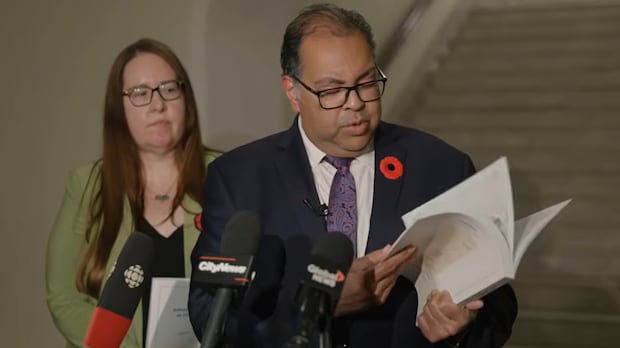

When Justice Dallas Miller, who chaired Alberta’s boundaries commission, offered politicians a limited opportunity to amend his panel’s findings and save two rural ridings from elimination, he included specific conditions to safeguard his electoral map.
The first stipulation, which the Smith government embraced, indicated that “the reinstatement of the two electoral divisions should not affect any electoral division in Airdrie or encompass areas south of Airdrie’s southernmost border…”
And indeed, where did the new boundary committee make its most contentious alterations?
In Lethbridge, Calgary, and Canmore—all located south of Airdrie.
NDP Leader Naheed Nenshi has labeled it a “Trump-style, MAGA gerrymandered map” that protects UCP-dominated areas in southern Alberta. Nenshi has cautioned that adopting it could lead to legal action against them.
Premier Danielle Smith has shown initial support for the revised plan, despite its apparent disregard for the conditions her party established for the new boundary advisory committee.
Back in April, when the United Conservatives halted the official commission’s findings, she maintained that she was accepting the majority report, but with Justice Dallas Miller’s additional recommendations which suggested minor adjustments.
“In his Recommendation Five, he provides specific guidance on the areas he considers problematic,” she remarked to the media.
However, the newly appointed panel led by retired judge Brian O’Ferrall did not feel constrained by the limits set by Miller and Alberta’s legislature, asserting in its “majority” report that the language in Miller’s fifth recommendation should not be regarded as “sacrosanct.”
“It was not the ‘Fifth Commandment,’” the report claims. “It was merely a minor political ‘give and take.’”
So, what alterations did O’Ferrall’s panel make?
It removed two urban seats from Lethbridge and divided one among three rural ridings that extend up to 150 kilometers in various directions to the U.S. border, the TransCanada Highway, Waterton Lakes National Park, and the hamlet of Manyberries, situated south of Medicine Hat.
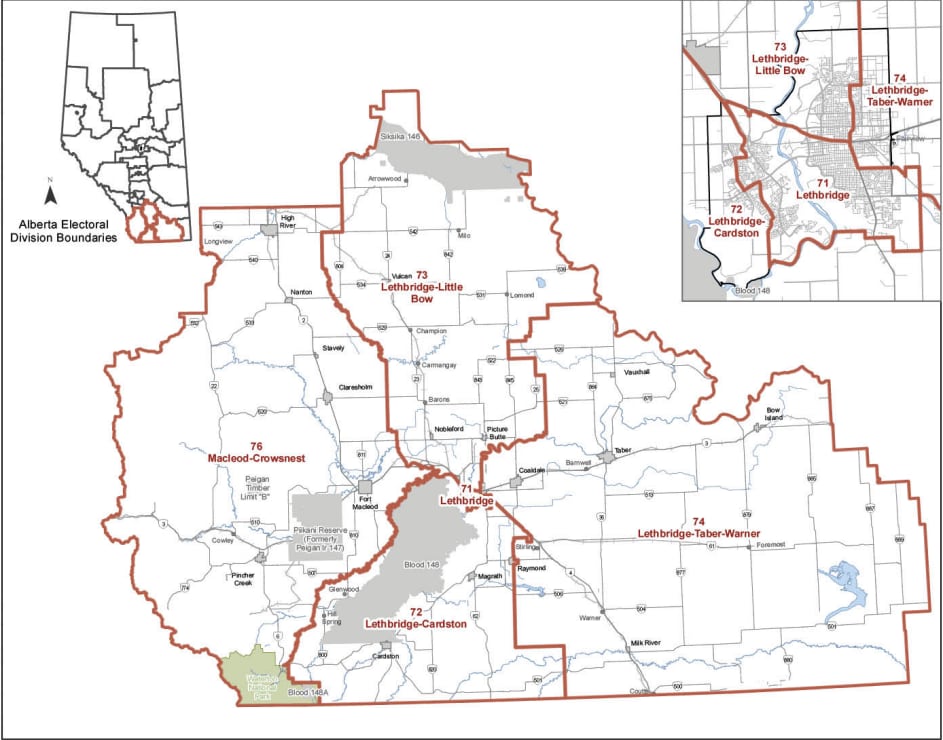
A map showing a sole Lethbridge urban seat, as well as three hybrid electoral divisions combining parts of the city with vast surrounding rural regions. (Advisory panel on electoral boundaries)
It redistributed rural acreage areas from the previously proposed Cochrane-Springbank riding among three west Calgary districts—an action that Nenshi contended supplies thousands of Conservative voters to seats currently occupied by three UCP cabinet ministers.
It removed the Diamond Valley and Longview regions from neighboring rural ridings south of Calgary and allocated them to the Canmore-Banff riding, which is on the opposite side of Kananaskis Country and a highway partially closed for six months each year.
Not only did Miller, the chair of the original commission, advise against such modifications in the interest of reinstating two rural ridings in northern and central Alberta, but it is also unclear whether these changes in southern Alberta were even necessary to facilitate the retention of those two districts.
These were not secondary effects resulting from the restoration of the riding in Rocky Mountain House and Sundre.
In the instances of Springbank and Bearspaw, it involved straightforward subtraction, division, and addition, independent of any mapping adjustments to the north.
According to the population statistics in the new report, Cochrane’s riding lost 9,703 residents, which were distributed among the three Calgary ridings, without any corresponding modifications to any other Calgary constituencies.
This leaves the reconfigured Cochrane with 46,785 inhabitants, which is 13 percent below the provincial average riding population. The restructured Calgary-West-Springbank and Calgary-Bow-Springbank each contain over 58,000 residents, nine percent above the average.
“Integrating Springbank into Calgary Bow is perceived as potentially benefiting the ruling party,” O’Ferrall’s report acknowledged. “However, whether this potential will materialize in the next election remains uncertain, even to pollsters with their voter transposition software.”
Springbank was reassigned because O’Ferrall and the panel’s UCP appointees believed that the rural area was more closely linked to Calgary than to the small town of Cochrane to its north.
Likewise, they felt that “Lethbridge is not an isolated urban municipality,” but rather the center of southern Alberta’s agricultural, health, and service sectors. Thus, it partially transforms into three hub-and-spoke ridings that nearly stretch from Saskatchewan to British Columbia—an alteration that the NDP contends diminishes one of Lethbridge’s politically competitive ridings and dilutes votes in UCP-favorable areas.

A newly proposed electoral map could add four more ridings and heavily shift boundaries across the province. We look at the controversial changes and ask how they might impact your community in the next election.
O’Ferrall and his UCP-appointed majority dismiss accusations that their work is unconstitutional as “polarizing nonsense.”
They similarly take offense in their report at the NDP-appointed minority’s objections regarding the new mapping in southern Alberta, stating, “It can be summed up quite simply. Our proposals are constitutional; yours are not. Our proposals are non-partisan; yours are not.”
For the record, Smith’s cabinet selected O’Ferrall, a former Court of Appeal judge who has contributed significant amounts to the UCP and federal conservatives since his retirement in 2022, and who previously served as a lawyer for an Alberta Progressive Conservative riding association two decades ago before becoming a judge.
The United Conservatives’ two appointees to the panel are Monte Solberg, a former Conservative MP and leader of a Calgary-based lobbying firm who has donated $2,883 to Smith’s party this year, including some contributions while on the panel; and Darwin Durnie, a longtime conservative political donor and municipal public works official who has a notable history as a boundary-making enthusiast, having proposed maps to Alberta’s boundary commissions that include several rural-urban hybrid ridings.
On the other hand, the NDP’s appointees, constitutional law professor Gerard Kennedy and former Okotoks councillor Brent Robinson, do not have any record of provincial donations in Elections Alberta’s database. Kennedy has made federal contributions, primarily to Conservatives and some to Liberals.
Regardless of the perceived partisanship of the boundary panelists, partisan MLAs are expected to debate the contentious report in the coming days.
Smith appreciates the concept of Lethbridge’s hybrid ridings, akin to how Medicine Hat is divided between her Brooks-Medicine Hat constituency and that of a UCP colleague’s Cypress-Medicine Hat.
“I represent a hybrid riding, and I believe Medicine Hat benefits from having two representatives. I think Lethbridge will also be very well served with four representatives,” she conveyed to the media on Tuesday.
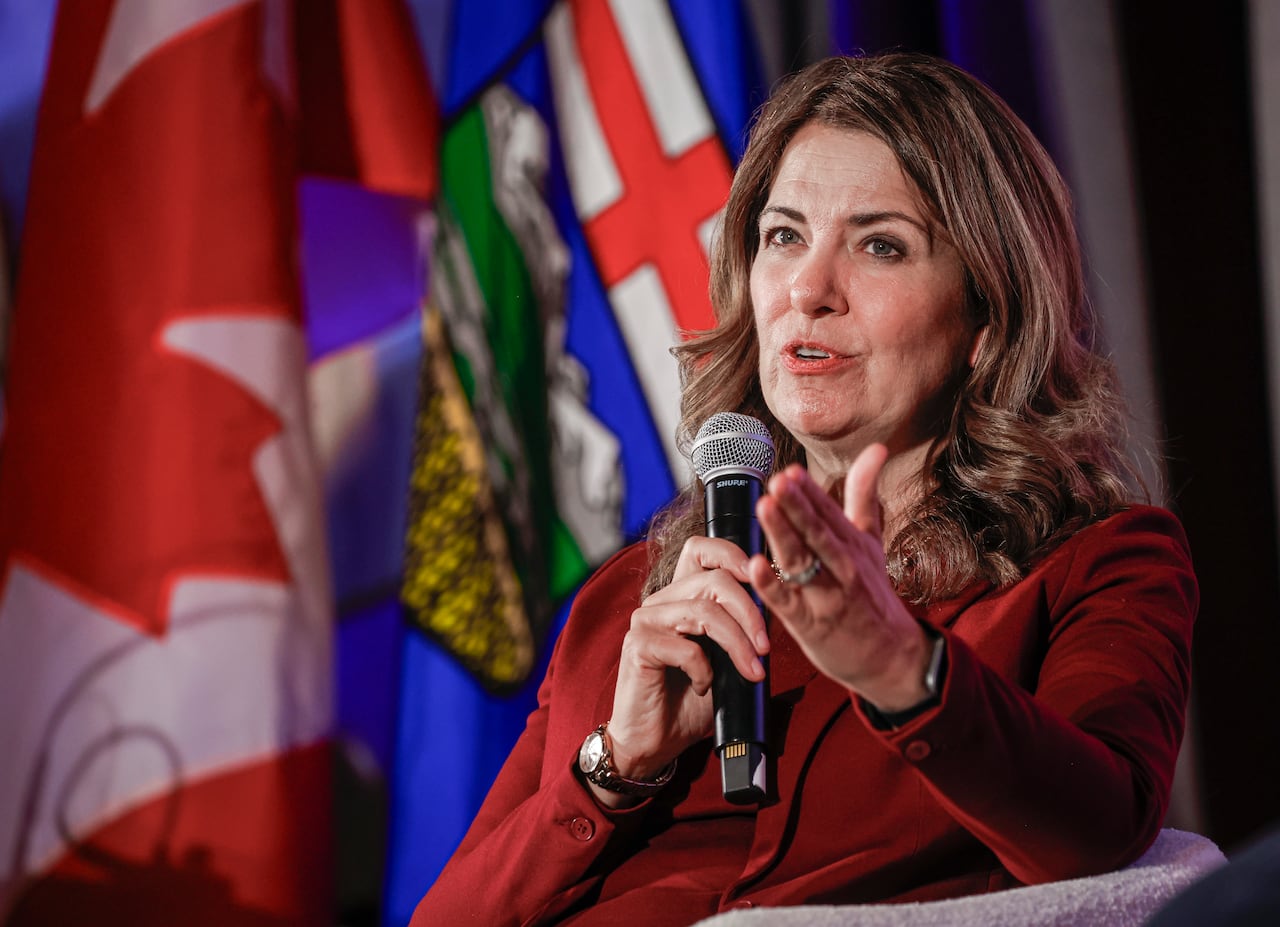
Premier Danielle Smith, who represents a rural-urban hybrid riding in Medicine Hat, stated that Lethbridge would benefit from having several rural-urban hybrid MLAs instead of just two city-only MLAs. (Jeff McIntosh/The Canadian Press)
The NDP cannot initiate a lawsuit against the new riding map until the legislature endorses it and it comes into effect. A successful legal challenge would need to argue that the ridings contravene the “effective representation” guarantees outlined in the Charter of Rights and Freedoms—this claim could theoretically arise from a political party or affected residents in Lethbridge or elsewhere, including the few thousand individuals in Springbank and Bearspaw who find themselves incorporated into 50,000-plus population seats in Alberta’s largest city.
Original commission chair Miller, for his part, noted in his report that he did not view Lethbridge or Springbank hybrids as “necessarily unreasonable or procedurally unfair,” mentioning that some members of the public had suggested them to the commission. However, that particular observation was not included in the government motion that initiated the redo of the boundary review, unlike the one advising against any redrawing south of Airdrie.
Smith indicated on Tuesday her readiness to “assemble a legal team” in anticipation of a possible court challenge. When asked about Miller’s caution regarding southern ridings, she replied, “I’ll examine it more closely and consult with the lawyers on that.”