

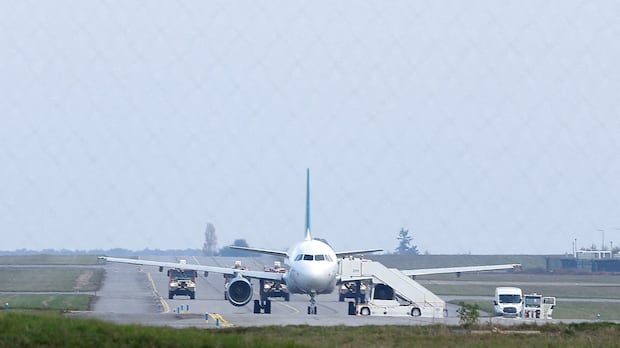

On Thursday morning, bomb threats led to unexpected landings of multiple flights across Europe, marking the latest incident in a series of threats aimed at air travel within the region.
Four flights bound for Prague reported receiving bomb threats, prompting police to prepare for their arrivals, as stated by Czech authorities on X. They assessed the credibility of the threats as low.
“However, we are not taking the threat lightly, which is why all essential security protocols have been initiated with minimal disruption to passengers and airport functions,” police stated. “Once they land, all aircraft will undergo explosive device inspections.”
Authorities in Bulgaria indicated that three planes executed emergency landings due to bomb threats.
A flight from Copenhagen and another from Madrid safely landed in Sofia, according to the interior minister, as reported by bTV.
Additionally, a third flight arriving from London landed in Plovdiv, local news outlets reported.
LOT Polish Airlines announced that a flight from Warsaw to Brussels successfully reached its destination following a security alert, although no threat was verified.
“After receiving information about a possible security threat to flight LO235 from Warsaw to Brussels, the flight crew was informed and conducted an onboard examination as per standard procedures. No suspicious items were discovered,” a spokesperson for LOT said.
Responsibility for threats remains unclear
The aircraft arrived at Brussels Airport, where security personnel conducted an additional examination of the plane.
An Aer Lingus flight, EI402 from Dublin to Rome, was redirected to Evreux airport, located 100 km west of Paris, as a precautionary measure, according to a statement from the Irish airline.
A Finnair flight from Helsinki was escorted to its planned landing in Rome by the Italian air force, as reported by a source familiar with the situation.
This past Tuesday, at least seven flights and a cruise ship were subjected to bomb threats, resulting in disruptions at airports throughout Europe, although no explosives were found.
-
String of bomb threats on flights, cruise ship disrupt travel across Europe
-
Another cyberattack on supermarket fridges sweeps Europe, leaving food spoiled
While no nation has claimed responsibility for these threats, they occur during a period when European officials have pointed fingers at both Russia and Iran, labeling them as perpetrators of “hybrid attacks” and acts of sabotage. Both Moscow and Tehran have denied involvement in any such campaign.
Incursions by drones have intermittently caused flight delays and cancellations across Europe, and recently, unidentified hackers disrupted refrigeration systems in supermarkets in various countries on the continent. Some experts suggest that the fake bomb threats may form part of a broader trend of low-cost, deniable disruptions.