

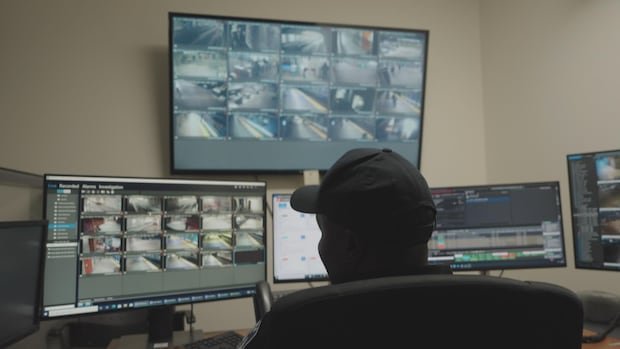

Artificial intelligence is currently being tested in Montreal’s Metro stations to identify individuals lingering near closing time, a move that has sparked mixed reactions among the public. Since the beginning of the year, the Société de transport de Montréal (STM) has been utilizing AI technology developed by Lipslogics, a local startup, to analyze surveillance camera footage at Papineau and Place-Saint-Henri Metro stations.
The AI system is designed to detect motion and send alerts to special constables one hour before the Metro closes, enabling them to intervene and guide individuals out of the stations. According to STM, in 2025, approximately 11,000 people had to be escorted out to facilitate the station closure due to nighttime construction activities.
Renaud Martel-Théorêt, a spokesperson for STM, highlighted the importance of finding more efficient methods to expedite station closures to prevent work delays and financial penalties from contractors. The chosen testing sites, Papineau and Place-Saint-Henri stations, were selected because special constables frequently assist individuals at closing time.
In a bid to enhance commuter safety, Montreal’s public transit agency has extended the ban on loitering in Metro stations. The policy, which requires individuals to be actively traveling within the network, will remain in effect until April 30, 2027.
Despite STM’s reassurances that the AI system does not perform facial recognition and data is securely managed on STM servers, concerns have been raised by experts and advocacy groups. Sébastien Gambs from Université du Québec à Montréal (UQAM) emphasized the need for transparency in the project and potential privacy implications. The Ligue des droits et libertés (LDL) also expressed reservations, cautioning against the use of AI for detecting loiterers, citing concerns about potential discrimination and privacy breaches.
STM recently allocated funds to Lipslogics to support the completion of the AI proof of concept. If the transit authority decides to proceed with the AI solution, additional communications will be deployed at the stations where the technology is utilized. This initiative follows STM’s previous collaboration with the Center for Suicide Intervention (CRISE) in implementing AI for suicide prevention strategies within the Metro.
Looking ahead, STM is exploring innovative solutions such as chatbots to enhance customer service efficiency while ensuring a careful approach to privacy and cybersecurity risks.