

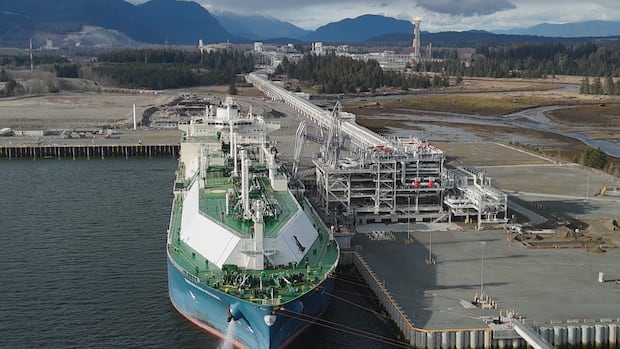

Canada’s sole liquefied natural gas (LNG) facility commenced operations last year, presenting a chance for the nation to enhance its industry and emerge as a leading natural gas exporter globally, as indicated by a recent report.
However, several challenges must be addressed, including a protracted permitting process and a scarcity of proposed initiatives from the private sector.
The federal government is targeting an increase in LNG exports to over 100 million tonnes annually.
At present, there is one functional facility with an annual capacity of 14 million tonnes.
Achieving the federal target could yield substantial economic benefits, as reported by S&P Global on Thursday, potentially generating nearly 250,000 jobs each year and attracting close to $1 trillion in investments in the natural gas sector by 2050.
“If Canada can tackle its permitting challenges and cost issues, it can significantly contribute to the global LNG market, which would be advantageous for the Canadian economy and help diversify its economic dependencies away from its southern neighbor,” stated Daniel Yergin, vice-chairman of S&P Global, during an interview with CBC News.
Western Canada possesses a significant supply of natural gas, which can be extracted at some of the lowest costs across North America.
Nonetheless, constructing pipelines to move gas from Alberta and northeastern British Columbia to the West Coast has proven to be a complicated and costly endeavor.
The Coastal GasLink project, initiated by TC Energy and partially owned by local First Nations, has encountered numerous delays and budget overruns. Various Indigenous communities and environmental advocates have opposed the project, which traverses approximately 625 bodies of water, including lakes, rivers, creeks, wetlands, and streams in northern B.C.
Some analysts have suggested that Canada may never become a dominant LNG exporter due to the considerable challenges associated with developing and constructing energy infrastructure. Additionally, Canada faces competition from numerous countries eager to attract LNG investments, including the United States.
According to the S&P report, Canada’s permitting timelines have extended 27 months longer than those in Texas, and the costs of building pipelines are 160 percent higher.
The federal government has proposed new legislation designed to expedite regulatory assessments.
LNG Canada remains the only operational LNG export facility in the nation, although there are six additional facilities either under construction or in the planning stages. Collectively, these would generate just over 50 million tonnes of LNG annually.

S&P Global vice-chairman Daniel Yergin appears on stage at CERAWeek in Houston on March 10, 2025. Yergin says Canada has many advantages and hurdles to grow its LNG sector. (Kaylee Greenlee/Reuters)
According to Yergin, one of the industry’s best-kept secrets is the scale of Canada’s oil and natural gas resources, coupled with its geographical benefit of a relatively short shipping distance to Asia.
“Asian buyers are interested in acquiring LNG from Canada,” Yergin remarked, noting that countries worldwide, particularly in light of this year’s Middle East conflicts disrupting the global natural gas supply, are eager for Canadian resources. European nations, in particular, are facing rising natural gas prices for heating homes as winter approaches.
“There is a strong demand for diversification. It’s essential to enhance security and resilience within your energy systems. A diverse portfolio is necessary, and having resources that don’t rely on choke points is advantageous. All these factors highlight the benefits that Canada currently possesses,” he added.
Yergin mentioned that Prime Minister Mark Carney holds significant credibility internationally, but investors will seek evidence of reforms in the permitting process, as prolonged wait times can incur substantial costs for companies.
The demand for natural gas is predicted to rise over the next several decades, driven by factors such as a growing global population and increased energy requirements from AI data centers and air conditioning systems.
S&P Global reports that Canadian LNG has 55 percent lower greenhouse gas emissions intensity compared to analogous projects in other nations.