

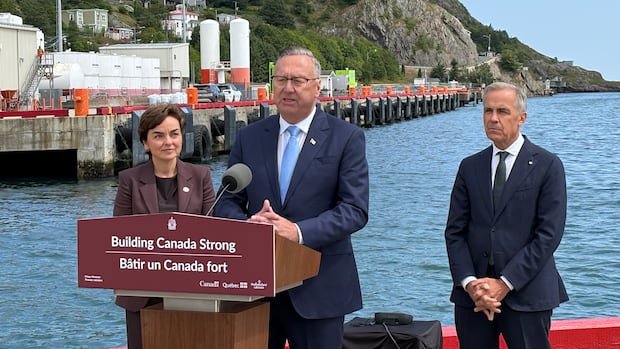

Ottawa has announced what is being hailed as the largest clean energy investment in North American history. Prime Minister Mark Carney, along with N.L. Premier Tony Wakeham and Quebec Premier Christine Fréchette, revealed a groundbreaking new agreement on Churchill Falls and other energy projects in Labrador during a gathering at Pier 17 in St. John’s.
The new deal involves $10 billion in federal funding to enhance the Churchill Falls generating station, advance the Gull Island hydroelectric project, construct transmission lines, and introduce a 2,000 MW onshore wind energy project in Labrador. These initiatives, collectively valued at nearly $70 billion, are set to significantly boost the generating capacity of Churchill Falls, providing enough power to illuminate, heat, and cool all the residences in Toronto, Montreal, and Vancouver combined.
The projects are anticipated to create 23,000 jobs, according to the federal government. The agreement between Newfoundland and Labrador Hydro and Hydro-Quebec, set to be signed on Monday, is expected to increase the net present value for Newfoundland and Labrador from $36 billion to $49 billion.
N.L. Premier Wakeham expressed satisfaction with the agreement, emphasizing that it will bring more power, value, and transmission capabilities to the region. The agreement includes upgrades to the existing Churchill Falls facility, with plans to expand its capacity by 23.5%, equivalent to an additional 1,275 MW.
Moreover, the agreement outlines further studies on the potential expansion of Churchill Falls and the development of a new wind project generating facility. These developments are poised to provide Newfoundland and Labrador with an additional 760 MW of power, potentially reaching up to 2,750 MW with the completion of the wind project.
The increased power supply is expected to benefit Labrador’s mining industry, with Ottawa allocating over $2.3 million for engineering studies on transmission lines and providing funding for the Kami iron ore project. The new agreement signifies a significant step towards a more sustainable and prosperous energy future for the region.