

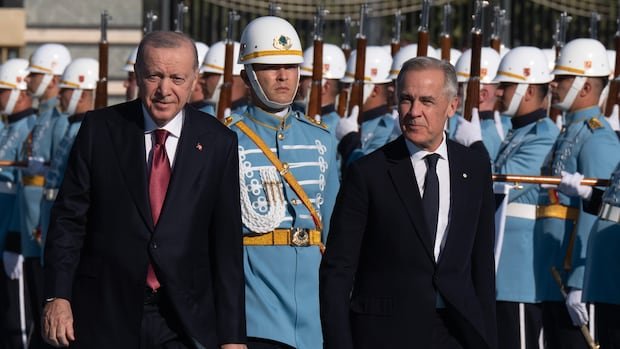

Prime Minister Mark Carney initiated a delicate diplomatic and economic maneuver on Thursday with Turkish President Recep Erdogan by unveiling a strategic collaboration focused on enhancing trade and defense ties. This move signifies a further enhancement in relations between the two nations and marks a significant step in the prime minister’s strategy to foster closer partnerships with other middle-power countries.
During a joint statement at the grand presidential palace compound, Carney lauded Turkey as an “exceptional” ally, emphasizing the importance of countries leveraging their respective strengths and working together with trusted partners to achieve collective resilience rather than self-sufficiency. The partnership framework comprises four key pillars: trade and investment, defense and security, energy, and people-to-people connections.
Upcoming negotiations in Ankara will kickstart discussions on a free trade agreement, with a fresh defense industry collaboration pact also in the works to facilitate closer ties between Canadian and Turkish firms. Furthermore, the partnership will facilitate investments in the energy and critical minerals sectors and solidify an air transport agreement to boost passenger flights between the two nations.
While the bilateral visit underscores Canada’s efforts to diversify its trade relationships beyond the United States, Turkey emerges as a pivotal ally due to its NATO membership and burgeoning defense sector. Despite Turkey’s authoritarian shift under Erdogan’s leadership, the Canadian government’s decision to engage with a diverse range of partners, including those with differing human rights records, is aimed at maximizing trade opportunities.
Carney’s visit to Turkey also included a visit to Anitkabir, the Mausoleum of Mustafa Kemal Atatürk, where he paid his respects by laying a wreath. As Turkey plans to significantly expand its energy capacity, discussions are reportedly underway to explore the potential involvement of Canada’s Candu nuclear team in constructing Turkey’s future nuclear power plants.
The prospect of a nuclear deal with Turkey has drawn scrutiny, especially considering past tensions that led to a de facto arms embargo by Canada, later partially lifted. The fallout between the two nations stemmed from discrepancies in the usage of imported equipment, raising concerns about transparency and trust in the bilateral relationship.
Overall, Carney’s diplomatic tightrope act in Turkey signifies Canada’s ongoing efforts to forge strategic partnerships globally while navigating complex geopolitical landscapes and balancing economic interests with human rights considerations.