

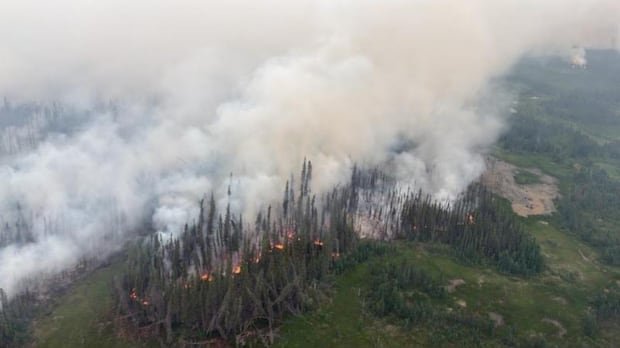

A climate expert warns that the window for building a major infrastructure project in the Northwest Territories is shrinking due to longer fire seasons, larger fires, and melting permafrost. The federal government recently halted work on the proposed Mackenzie Valley Highway, a gravel road connecting remote communities from Wrigley to Inuvik, citing uncontrollable wildfires.
Ze’ev Gedalof, a climate scientist at the University of Guelph, predicts that wildfires could become the new normal in the N.W.T. with shorter ice road seasons complicating transportation logistics. The region has witnessed an increase in wildfires, leading to evacuations in communities and Yellowknife. Currently, over 200 active wildfires are raging in the N.W.T., most of which are uncontained.
A study by the World Weather Attribution indicates that wildfires are expected to occur more frequently in the N.W.T. due to climate change. The Mackenzie Valley Highway, envisioned to reduce living costs and assert sovereignty in the North, faces uncertainties amid harsh wildfire seasons.
Rebecca Alty, the territory’s member of parliament, emphasizes the need to approach the project cautiously in response to the challenges posed by nature. Meanwhile, federal minister Eleanor Olszewski expresses concerns about the impact of climate change on wildfires, advocating for preparedness and public awareness to mitigate human-induced fires.
Premier R.J. Simpson underlines the importance of completing the Mackenzie Valley Highway, describing its failure as a significant setback for the territory. Despite potential delays caused by wildfires, he remains optimistic about the federal government’s commitment to the project, aiming for full construction to commence next year.