

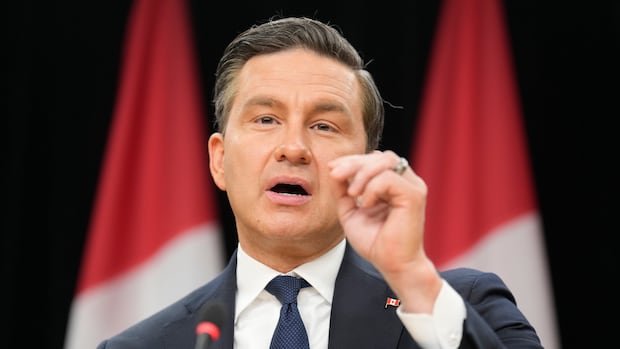

Conservative Leader Pierre Poilievre has urged Prime Minister Mark Carney to exhibit strength in ongoing trade discussions with the United States. Poilievre, along with Canada-U.S. relations critic Shuvaloy Majumdar, highlighted instances where Ottawa has acquiesced to demands from the U.S. over the past year.
Specifically, they pointed to actions such as scrapping the digital service tax, eliminating Canada’s counter-tariffs, and incorporating the United States into an agreement to share toll revenue from the Gordie Howe International Bridge. Poilievre criticized Carney for what he perceives as a pattern of yielding ground without receiving reciprocal benefits, leading to job losses in Canadian cities reliant on cross-border supply chains.
The letter to Carney emphasized concerns about escalating American tariffs on Canadian steel, aluminum, and lumber. Poilievre emphasized the need for a favorable trade deal for Canadians, including provisions such as zero tariffs on softwood lumber, the removal of sectoral tariffs on steel and aluminum, a tariff-free auto pact, and complete exemption from Buy America rules for infrastructure projects.
The Conservatives reiterated their call for Canada to fortify its negotiating stance by establishing a strategic reserve of critical minerals, contingent on countries offering tariff-free market access. Meanwhile, discussions around extending the Canada-United States-Mexico Agreement (CUSMA) have seen differing views, with the U.S. favoring rolling annual reviews over a long-term extension.
In the dairy sector, the U.S. has raised concerns about Canada’s supply management system and access to its dairy market. While Carney reaffirmed support for the system, the Dairy Farmers of Canada urged against concessions in trade talks, citing repeated Canadian compromises met with fresh American demands.
Trade tensions are set to heighten with impending 50% U.S. tariffs on various Canadian goods. The Canadian government is reportedly considering meeting certain U.S. demands, such as lifting bans on American alcohol sales and potentially adjusting policies on autos and dairy, in exchange for tariff relief and resuming CUSMA discussions in the fall.