

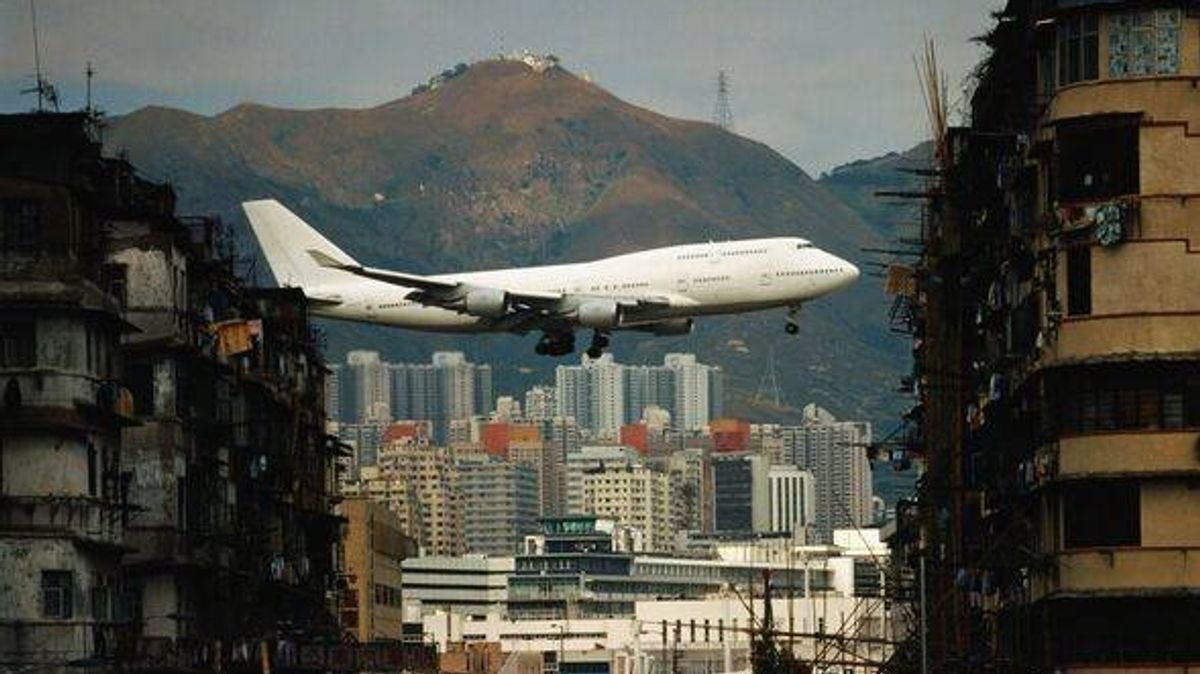

In the past, Kai Tak Airport in Hong Kong was renowned as one of the most challenging landing spots globally, causing even experienced pilots to feel anxious. Situated amidst skyscrapers, mountains, and Victoria Harbour, the concrete runway posed a nerve-wracking experience for millions of passengers over 73 years. Approaching planes flew close to residential buildings, requiring pilots to execute a precise 47-degree turn known as the ‘Hong Kong Turn’ to align with a distinctive red-and-white checkerboard on a hill.
Videos from that era depict jumbo jets battling strong crosswinds, making dramatic landings on a runway that ended close to the harbour waters. The airport, dubbed ‘Kai Tak Heart Attack,’ was a crucial hub for airlines like Cathay Pacific and Dragonair, contributing significantly to Hong Kong’s economy. However, space constraints and noise pollution issues prompted authorities to construct a new airport at Chek Lap Kok, leading to Kai Tak’s closure in 1998.
Despite its daunting reputation, Kai Tak symbolized the pinnacle of aviation skill, attracting awe from onlookers. Today, the once-intimidating Kai Tak Airport has undergone a remarkable transformation into a vibrant district as part of Hong Kong’s harborfront revitalization project. The former runway now serves as the Kai Tak Cruise Terminal, a modern complex welcoming large cruise ships.
Adjacent to the terminal, a serene public park offers stunning sea views, where visitors enjoy leisurely strolls in the same space where planes once landed. The surrounding area is witnessing rapid development with luxury residences, retail spaces, sports facilities, and hotels, shaping Kai Tak into a trendy neighborhood. While the site no longer instills fear in flyers, its legacy as a historic aviation landmark endures, evoking memories of its thrilling past for those who experienced it firsthand.