

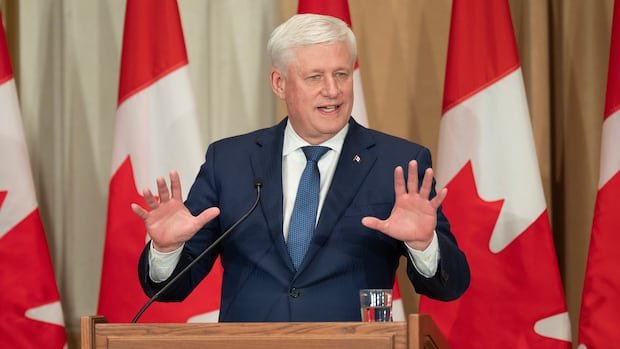

Former Canadian Prime Minister Stephen Harper expressed his concerns about the idea of Alberta separating from Canada in an article published on Friday. Harper emphasized that voting for separation, even as a symbolic gesture, would be a risky and complex endeavor due to the lack of credible leadership to establish a new country.
On October 19, Alberta voters will decide whether the province should remain part of Canada or proceed with a second referendum on separation. Harper, during the unveiling of his official prime ministerial portrait earlier this year, called for unity between Liberals and Conservatives in response to the growing separatist movements in Alberta and Quebec.
Harper supported the federal government’s decision to walk away from trade talks with the United States, emphasizing the need for Canada to reduce its dependence on the U.S. to safeguard its sovereignty. Current Conservative Leader Pierre Poilievre has also voiced his support for a united Canada, attributing provincial discontent to the Liberal government’s actions but dismissing separation as a solution.
Harper warned against the idea of voting for separation merely to convey a message, stating that such a move could perpetuate the threat of separation without addressing underlying issues. Polls have consistently shown that a majority of Albertans prefer to remain within Canada, although separatist leaders are striving to sway opinion by advocating for a binding referendum to leverage Alberta’s position in negotiations with Ottawa.
Despite Harper’s stance as a federalist, some analysts believe recent events, such as discussions around the West Coast oil pipeline, may already be influencing federal attention towards Alberta’s concerns. Harper also asserted that his government’s approach to energy policy helped quell separatist sentiments during his tenure. Poilievre echoed this sentiment, claiming separatism was eradicated in Alberta and Quebec under Harper’s leadership, which was met with criticism from the Bloc Québécois.
Cory Morgan, leading the pro-independence group Pathway to Independence, acknowledged Harper’s federalist stance but highlighted recent developments as indications that the referendum is resonating with Ottawa. Harper’s spokesperson declined to provide further comments on the matter.