

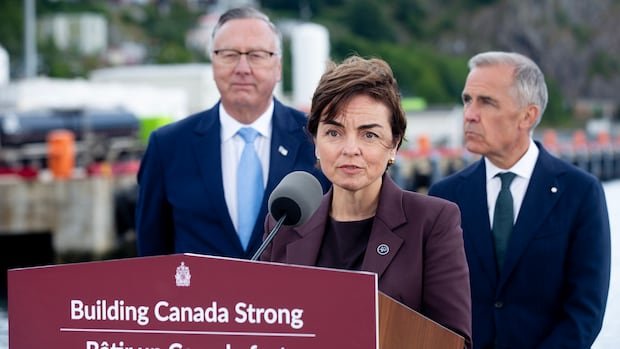

Prime Minister Mark Carney visited St. John’s on Monday to reveal a new agreement concerning Churchill Falls and additional electricity projects in Labrador, accompanied by N.L. Premier Tony Wakeham and Quebec Premier Christine Fréchette. This agreement is positioned as the most extensive clean energy investment in North American history, valued at nearly $70 billion, with $10 billion in federal financing from Ottawa. The funds will be utilized for enhancing and expanding the Churchill Falls generating station, advancing the Gull Island hydroelectric project, constructing transmission lines, and implementing a 2,000-megawatt onshore wind energy project in Labrador. These developments will boost Churchill Falls’ current generating capacity, providing enough electricity to power the homes in Toronto, Montreal, and Vancouver combined.
The framework announced on Monday is effective until March 2027, awaiting a definitive agreement to be signed, ideally by the year’s end. However, with the provincial election set for October 5, a change in government might occur before the deal is formally sealed.
Under this new deal, Quebec stands to gain access to over 10,000 megawatts, which is more than a quarter of Hydro-Québec’s current output. The electricity from Churchill Falls will be sold to Quebec at an average price of 6.2 cents per kilowatt-hour, potentially resulting in savings of $200 billion throughout the agreement’s duration. Experts view this agreement as a significant milestone for Quebec’s energy sector, with potential benefits for consumers by maintaining low rates.
For Premier Fréchette, this deal signifies a pre-election victory and an opportunity to showcase her economic expertise. She highlighted the partnership’s significance in ensuring Quebec’s energy security for the next five decades and creating numerous job opportunities. The looming provincial election has sparked debates and criticisms, with opposition leaders expressing skepticism and concerns.
The Innu nations of Matimekush-Lac John and Uashat mak Mani-utenam emphasized the need for their consultation and consent in the Churchill Falls project, raising historical land ownership issues and ongoing court cases. The agreement’s impact on Quebec’s upcoming election campaign has stirred controversy and differing opinions among political parties, with each voicing their perspectives and proposals regarding the deal’s implications and future directions.