

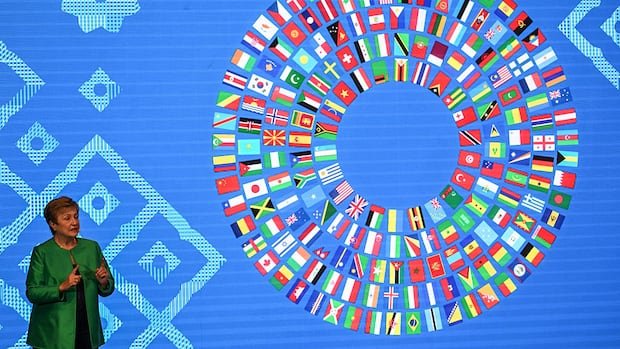

The International Monetary Fund (IMF) adjusted its global economic forecast for this year, anticipating a 3.1 percent growth rate. This is a slight increase from the previous projection of three percent in July, but still lower than the 3.5 percent expansion seen in 2025. The IMF’s latest Economic Outlook, released during the fall meetings of the IMF and World Bank in Bangkok, suggests that the United States will maintain a steady growth rate of 2.3 percent in 2026 and 2027.
Advanced economies are expected to grow at a rate of 2.1 percent this year, up from two percent in 2025, before slowing down to 1.9 percent growth in the following year. The IMF’s forecasts are based on a nearly 41 percent surge in oil prices this year, averaging $96 US per barrel. Global inflation is projected to reach 4.7 percent in 2026 but is anticipated to decrease to 4.1 percent in the next year.
The IMF’s outlook also factors in the assumption that oil and gas shipments through the Strait of Hormuz will resume by March, and that the surge in demand for artificial intelligence (AI) will stabilize.
The IMF economists highlight that the rapid growth in AI is offsetting the challenges posed by rising energy prices. However, they caution that the unequal distribution of AI benefits poses risks. The report indicates that the U.S. and China account for over three-quarters of the net demand for AI-related imports, concentrating growth in select countries.
Athanasios Vamvakidis, the IMF’s deputy director, points out that corrections in stock markets related to AI and escalating bond yields are emerging risks. Additionally, cyber threats could potentially disrupt financial systems. Recent sell-offs of AI-related shares in Asia underscore these concerns, with South Korea’s Kospi experiencing significant declines.
Regarding employment impacts, IMF managing director Kristalina Georgieva warns of the gradual but substantial effects of AI on jobs globally, estimating that around 40 percent of jobs may be affected by AI-related changes.
The IMF emphasizes the importance of addressing high levels of debt and improving national finances, particularly as borrowing costs remain elevated. Countries insulated from energy shocks and benefiting from AI adoption are better positioned for growth. However, developing economies vulnerable to energy cost hikes are expected to experience slower growth this year, with a projected recovery in 2027.
The outlook is particularly challenging for the Middle East and Central Asia, where economic contractions are anticipated this year, followed by a projected growth rate of 6.3 percent in 2027. Eurozone countries are forecasted to grow modestly at 1.1 percent in 2026 and 1.2 percent in 2027.
China is projected to expand by 4.5 percent this year, down from five percent in 2025, aligning with government targets. India is anticipated to maintain its position as the fastest-growing major economy, with a projected growth rate of seven percent, slightly lower than the previous year.
The IMF, a global financial institution aimed at fostering economic growth, financial stability, and poverty reduction, convened at the Bangkok meetings to assess the world economy’s status and strategize ways to support sustained growth and financial stability.