

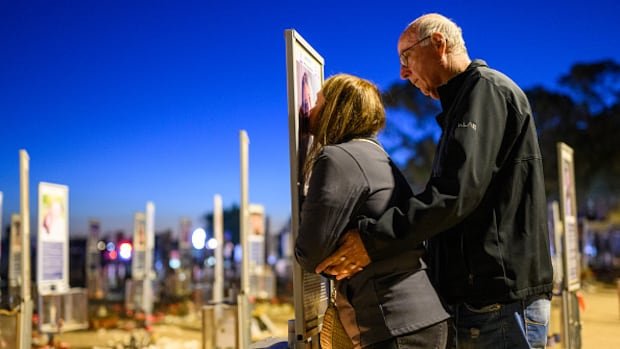

Israelis came together on Wednesday to remember the tragic events of Oct. 7, 2023, when a Hamas-led attack claimed the lives of 1,200 individuals, with 251 being held captive. This incident sparked a destructive conflict in Gaza, leaving significant devastation in its wake and forcing the two million residents of the region into dire living conditions.
In southern Israel, families gathered at various locations including intersections, bomb shelters, and the site of a music festival that was overrun by Hamas militants three years ago in a fatal assault on Israel. This year marks the first anniversary since all hostages were returned home, signifying a new phase of mourning.
Meanwhile, for Palestinians, the anniversary serves as a reminder of ongoing hardships and struggles following Israeli military actions in Gaza, resulting in the deaths of tens of thousands. With most of the population residing in overcrowded tent camps, and many parts of the cities reduced to rubble, daily life remains grim for the two million inhabitants.
Despite a ceasefire agreement reached nearly a year ago, over half of the territory remains under Israeli military control, and Israeli airstrikes persist on an almost daily basis.
The day also sheds light on the significant changes witnessed in the region over the past three years. Israeli forces currently occupy a substantial portion of southern Lebanon due to their conflict with Hezbollah, which began supporting Hamas in 2023 by launching attacks on Israel.
Moreover, tensions between Iran and the United States have escalated, resulting in cross-border attacks in Arab Gulf countries and causing disruptions in the global economy. While Israel played a role in triggering this conflict, the Gaza war indirectly paved the way for further developments.
In the town of Reim, where the music festival was tragically interrupted by the attack, families gathered to commemorate their lost loved ones. They observed a moment of silence at 6:29 a.m., the exact time the assault began three years ago, as echoes of explosions from nearby Gaza resonated in the background.
Elkana Bohbot, a former hostage who spent 738 days in captivity before being freed last year, is marking the first anniversary of his release in Israel. Bohbot endured harsh conditions, including confinement in a dark underground tunnel, limited food provisions, and sporadic bathing opportunities.
Since his release, Bohbot has undergone physical and emotional rehabilitation, authored a book, embarked on a speaking career, and made up for missed holidays and family celebrations. In a poignant moment, his wife gave birth to their daughter Michele in August, fulfilling a promise Bohbot made to himself during his time in captivity.
In Gaza, Palestinians continue to grapple with the aftermath of the conflict, with no official events scheduled for the anniversary. Hamas, in a statement, hailed the Oct. 7 attack as a display of heroism and national unity, underscoring its significance in drawing attention to the Palestinian cause globally.
The conflict has taken a heavy toll on Gaza’s population, with widespread destruction, displacement, and severe food shortages affecting around 90% of residents. The Health Ministry in Gaza reports over 74,000 casualties, with a majority being women and children. Despite a ceasefire in effect since October 2025, sporadic Israeli airstrikes persist, targeting alleged Hamas operatives.
The Oct. 7 attack, portrayed by Hamas as a response to long-standing grievances regarding Israeli actions, has further complicated the prospects for a peaceful resolution and Palestinian statehood.
Looking at the broader Middle East landscape, the anniversary coincides with a pivotal election in Israel, reflecting deep divisions over the government’s handling of the conflict. The attack set off a chain of events that triggered conflicts across the region, involving Israel, Hamas, Hezbollah, and Iran. The repercussions have been felt far beyond the region, with the United States engaging in military actions against Iran, leading to global economic disruptions.
Furthermore, violence has escalated in the Israeli-occupied West Bank, where extremist settlers, emboldened by the Israeli government, have targeted Palestinians and their properties, exacerbating tensions in the region.