

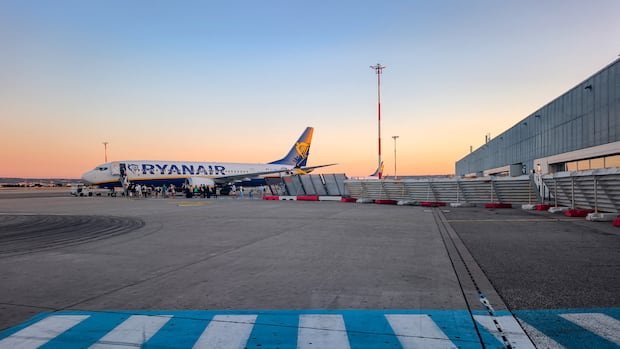

Broken engine components caused damage to a Ryanair aircraft shortly after it took off in Greece last month, resulting in a man’s head being drawn toward the opening before fellow passengers rescued him, according to U.S. investigators on Thursday.
The U.S. National Transportation Safety Board (NTSB) disclosed that a fan blade in the right engine of the Boeing 737-800 dislodged, sending fragments through the aircraft’s structure. The occurrence on July 10 transpired after the plane left Thessaloniki in northern Greece. Investigators discovered bird remnants in the engine, implying potential bird strikes during takeoff, although the cause of the fan blade detachment remains undetermined.
The 61-year-old man almost ejected from the plane sustained neck and shoulder injuries and friction burns. Flight attendants reported hearing loud, continuous vibrations and observing smoke or mist inside the cabin, prompting the release of oxygen masks.
Passengers noticed the man in a row 11 window seat partially lodged in a damaged window. They swiftly pulled him back inside the cabin. Subsequently, the injured passenger received medical attention from a doctor-passenger in row 12. Other passengers assisted in blocking the broken window with a metal box until the aircraft could land safely.
Videos captured from within the plane depicted passengers donning oxygen masks after the cabin lost pressure. The footage also showed a man seated near the blown-out window wearing an oxygen mask and first responders working in the aisle post-landing.
Ryanair commented last month that the flight returned to Thessaloniki shortly after takeoff due to a passenger window dislodging in-flight. International aviation regulations allow Greece’s Hellenic Air and Rail Safety Investigation Authority to transfer investigations to the NTSB, which occurred in this instance with Greek involvement.
The NTSB criticized Ryanair CEO Michael O’Leary for prematurely discussing the investigation’s focus on foreign object damage rather than the aircraft’s age or maintenance history, as investigators had not ruled out any possibilities.
Maintenance records revealed that the failed fan blades underwent ultrasonic inspections in May 2026 and November 2025, with no damage detected. However, flight crews reported four suspected bird strikes on the same engine over the past year, with bird remains found after two incidents. The maintenance intervals appeared to be adhered to, but investigators will scrutinize how the inspections were conducted and whether the previous bird strikes contributed to engine damage.
Ryanair, Boeing, and CFM International, the engine manufacturer, were contacted by The Associated Press for comments on the NTSB findings. Previous incidents involving CFM engine failures breaching the aircraft’s cabin were highlighted, including fatal events in 2018 and 2016 on Southwest Airlines flights.
The aircraft involved, capable of accommodating up to 189 passengers, was delivered new to Ryanair in 2008. Flight-tracking data revealed that the plane climbed to over 4,570 meters after takeoff, then descended to about 1,830 meters to burn fuel before returning to Thessaloniki.
Operated by Malta Air, a Ryanair subsidiary, the flight landed safely, and passengers disembarked back at the terminal. Medical assistance was provided to one passenger in Thessaloniki upon landing, as reported by the airline.