

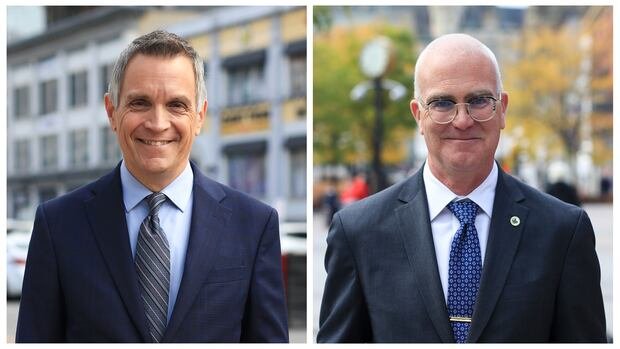

With the election day approaching in less than a week, a recent opinion poll indicates that incumbent Mark Sutcliffe is ahead of three-term city councillor Jeff Leiper in the mayoral race, with a significant lead. According to the survey by Quorus Consulting Group released on Monday, Sutcliffe holds 28% of the support from all respondents, while Leiper follows closely at 24%. Neil Saravanamuttoo and Alex Lawson trail behind at seven and four per cent, respectively.
However, a notable portion of respondents, about one-third, either remain undecided, do not plan to vote, or choose not to disclose their preference. Among those who expressed their choice, Sutcliffe leads with 42%, compared to Leiper’s 35%. Saravanamuttoo stands at 10% and Lawson at seven percent, inclusive of those who have already voted in advance polls.
Despite the narrowing of the race, Sutcliffe maintains a comfortable lead over Leiper, as stated in the summary of results by Quorus. The online survey, conducted from October 8-15, gathered insights from 807 randomly selected Ottawa residents. Quorus, a reputable market research firm with affiliations with organizations like Elections Canada, produced this independent survey.
The poll also revealed that four percent of respondents favored candidates outside the top four contenders, a figure that rose to six percent among those who expressed their preferences. Notably, a total of 14 candidates are vying for the mayoral position in Ottawa.
The survey delved into the top issues influencing voters’ decisions, with housing, affordability, and cost of living emerging as the key concern for 20% of respondents. This was followed by transit at 15%, taxes, budgets, and fiscal management at 12%, competence, leadership, and integrity at 11%, and roads, infrastructure, and traffic at 10%. Crime, public safety, and policing lagged behind at three percent.
Quorus conducted and sponsored the poll, with respondents drawn from a Leger’s opt-in panel. The results were weighted based on census data to ensure a representation of the city’s demographic diversity. While the survey lacks a margin of error, a random sample poll of the same size would typically have a margin of error of plus or minus 3.5%, 19 times out of 20.