

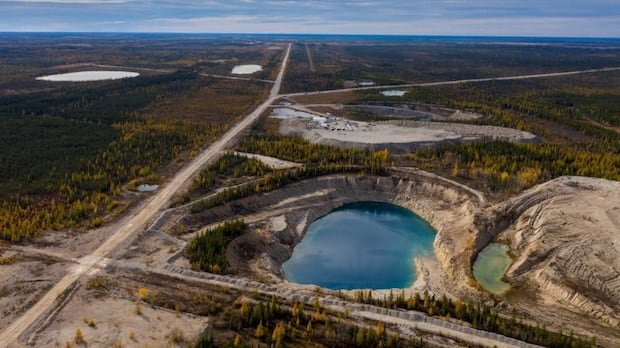

During her visit to Ottawa last week, N.W.T. Minister of Industry, Tourism, and Investment Caitlin Cleveland advocated for the implementation of new federal tax credits to stimulate mining activities in the region and throughout Northern Canada.
Cleveland, alongside a delegation of government officials and Indigenous leaders from the N.W.T. Council of Leaders, emphasized the importance of investing in major projects. She specifically pushed for the introduction of the North of 60 Mineral Exploration Tax Credit, a proposed 15% tax incentive applicable to companies operating in the three northern territories: N.W.T., Nunavut, and Yukon. This credit would complement existing national exploration incentives.
Additionally, Cleveland urged the inclusion of zinc in the list of minerals eligible for a clean technology manufacturing investment tax credit. Currently, the federal government offers a 30% tax credit for machinery and equipment used in mining operations involving 11 minerals, excluding zinc. Cleveland highlighted zinc’s significance in renewable energy and power storage, labeling its exclusion as a missed opportunity by Ottawa.
The minister stressed the critical role of these tax credits in fostering new mining projects amid intense global competition. She expressed optimism following constructive discussions with her counterparts and emphasized the necessity of these incentives to drive economic growth in the territories.
Cleveland pointed out the decline in mining activities in the region due to the closure of diamond mines and the absence of immediate replacements. She underscored the importance of leveraging major projects like the Arctic Economic and Security Corridor and the Mackenzie Valley Highway to spur mining initiatives and avoid stagnation.
Several key mineral projects, including zinc deposits, were highlighted at a recent investment summit, showcasing the potential for growth through existing infrastructure and permits. Cleveland noted the enthusiasm of proponents for projects like PC Silver and Pine Point mines, emphasizing the transformative impact of including zinc in the clean energy tax credit to facilitate project commencement and enhance Canada’s production capacity.
The combined efforts could generate significant employment opportunities, with an estimated 1,000 jobs during the construction phase and 600 jobs during operation, according to Cleveland.
The push for a North of 60 exploration tax credit dates back to 2014, initiated by the N.W.T. and Nunavut Chamber of Mines. The current CEO, Paul Hébert, advocated for a higher credit rate, citing the need for federal support to enhance the region’s competitiveness in mining development compared to southern Canada.
Hébert highlighted the challenges faced by the territories in attracting investments due to limited tax bases and population sizes. He emphasized the potential of tax incentives to make the territories more appealing to investors from a taxation perspective.
Having advocated for over a decade for new tax incentives, Hébert anticipated government action, pointing to recent announcements of tax credits. He expressed confidence in Ottawa’s commitment to supporting the mining industry, expecting positive policy changes to benefit the Canadian mining sector.