

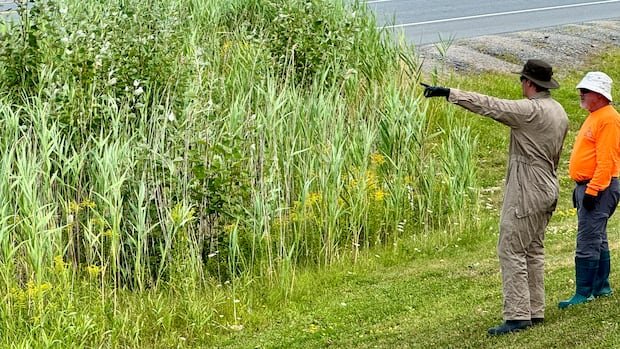

An invasive plant is spreading further into northern Ontario, prompting communities to take action to identify and control it before it establishes itself firmly. The Junction Creek Stewardship Committee, based in Sudbury, organized a workshop in collaboration with the Invasive Phragmites Control Centre to educate individuals on recognizing invasive phragmites and preventing its spread.
Invasive phragmites, also known as common reed, can form dense stands that displace native plants and disrupt wetland ecosystems. Jayden McGleish, a field supervisor at the Invasive Phragmites Control Centre, mentioned that the plant is making its way into northern Ontario, with significant patches emerging in Sudbury.
The invasive species can outcompete native plants like cattails and bulrushes, creating obstacles for wildlife. McGleish highlighted the challenges faced by turtles and frogs navigating through dense phragmites patches, leading to some unfortunate incidents.
Moreover, invasive phragmites can encroach on recreational areas, swallowing shorelines and impeding access. The plant’s ability to grow along roads and even through asphalt poses additional problems for municipalities, affecting drainage systems and causing damage to roads.
While the invasive plant is more prevalent in southern Ontario, it is increasingly being detected in northern communities such as Sudbury, Sault Ste. Marie, Timmins, and Thunder Bay. Erik Barr, a contract employee at Conservation Sudbury, emphasized the importance of taking action early to prevent the invasive plant from spreading uncontrollably in Sudbury.
To distinguish invasive phragmites from native varieties, individuals need to observe key characteristics. Barr noted that the invasive type typically features wider leaves and thicker stems, while the native plant displays a reddish coloration on its stems. Additionally, a thin brown line at the leaf-stem junction distinguishes invasive phragmites from native varieties.
Educating the public on identifying the plant is crucial for monitoring and mapping its spread. Jaclyn Groom from the Junction Creek Stewardship Committee highlighted the prevalence of invasive phragmites along roads and railways in Sudbury, emphasizing the risk of inadvertent spread by vehicles and equipment.
Efforts to manage invasive phragmites include utilizing backpack sprayers and a herbicide called Timberline. Chuck Simpson, the manual controls manager at the Invasive Phragmites Control Centre, explained that although some plants may regrow the following year, treatment can achieve a high kill rate of 95 to 97 percent. Demonstrations of treatment methods were showcased at a culvert near Ramakko’s sports store in Sudbury, showcasing the effectiveness of controlling the invasive plant.
Overall, proactive measures and public awareness are essential in combating the spread of invasive phragmites in northern Ontario.