

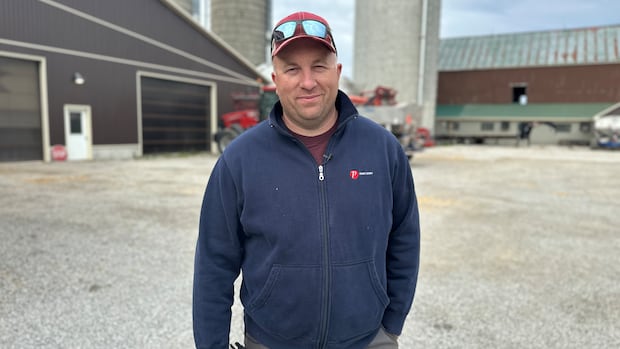

As the harvest season unfolds across Canada, Drew Spoelstra from Hamilton is contemplating potential future challenges due to escalating fuel prices, costly machinery, and the unpredictability surrounding U.S. tariffs.
Spoelstra operates a farm located near Binbrook in Hamilton and serves as the president of the Ontario Federation of Agriculture.
He noted that this year’s harvest has been successful, largely due to favorable weather conditions, yet the expenses associated with harvesting have become increasingly burdensome.
“In the past, filling our combine for a day’s work cost around $1,000; now it’s doubled to $2,000,” he remarked.
Farmers are contending with surging prices for fertilizers, machinery, and other resources, while struggling to transfer these costs to consumers.
“We are not buying and selling at a price that allows us to pass these costs along,” Spoelstra stated.
Escalating equipment expenses
Spoelstra runs a family-operated dairy, grain, and Clydesdale breeding farm, managing approximately 728 to 769 hectares in the Hamilton area.
He cultivates corn, soybeans, wheat, and hay, using some of the produce to feed livestock while selling the rest in local and international markets.
Although the farm has never acquired a new combine, Spoelstra indicated that the cost to replace their 2013 model has surged significantly.
The original price of the machine was around $500,000, but its current replacement cost is approximately $1 million, he noted.
“I didn’t spend a million dollars on a farm, let alone a million for a piece of machinery that I only utilize for two months each year,” he added.
The increase in machinery costs is mirrored by a decline in equipment sales.
The Association of Equipment Manufacturers has published a report indicating that Canadian tractor sales dropped 15.1 percent in September 2026 compared to the same month in 2025, with combine sales experiencing a decrease of 37.6 percent.

Tractors like the Case IH Magnum 280 represent significant investments for farmers. Spoelstra emphasizes that maintenance costs are steep, and the price of replacement parts is on the rise. (Jeffery Tram/CBC)
Colin Mang, an economist at McMaster University, noted that tariffs are compounding the difficulties for farmers, even if their specific crops are not subject to U.S. duties.
The Canadian government has exempted certain agricultural machinery, including tractors and combines, from counter-tariffs. However, some trailers for farming and livestock still incur a 25 percent tariff.
American tariffs on parts manufactured in Canada also elevate costs for producers, which can then be transferred to farmers purchasing equipment.
“Regrettably, Canadian farmers are caught in this situation,” Mang remarked.
He suggested that some farmers might consider sourcing equipment from Europe, but high shipping costs and supply chain issues could deter this option.
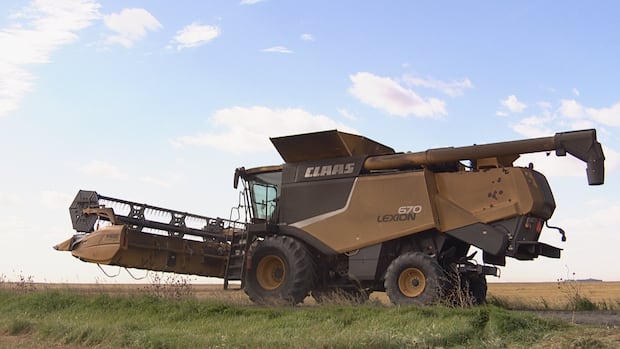
Combine manufacturer CLAAS is shifting the production of its products bound for Canada from Omaha, Nebraska, to Harsewinkel, Germany.
Trade uncertainty burdens farmers
Mang indicated that while most agricultural products from Canada continue to enter the U.S. without tariffs, trade barriers have intensified for particular sectors.
Canadian dairy products, such as milk, cheese, and whey, have been especially impacted by U.S. trade restrictions, he explained.
In a typical year, Canada exports around $350 million to $400 million worth of dairy to the U.S. while importing approximately $1 billion in American dairy products, according to Mang.
Canadian counter-tariffs on U.S. dairy have also caused disruptions in trade.
For farmers, the ambiguity surrounding future trade agreements presents yet another hurdle in making long-term business choices.
Spoelstra expressed that the most significant effect of the trade conflict has been the increased expenses related to equipment, fuel, and other essentials.
“We are uncertain about what a trade deal will entail, if one will be established, or how it might influence agri-food products,” he stated.
Mang noted that Canada is attempting to diversify its agricultural export markets, including efforts to restore trade with China earlier this year.
However, he emphasized that the U.S. remains a crucial market for Canadian farmers due to its geographical proximity and lower transport costs.
“Geographically, diversifying in agriculture is more challenging than in other sectors,” he remarked.
For many farmers, selling products closer to home is often the most viable option, especially for perishable goods.
The economic significance of agriculture
Spoelstra emphasized the need for governments to view agriculture as a vital economic sector, on par with industries like steel, automotive, and energy.
The agri-food industry in Ontario contributes approximately $52 billion to $53 billion to the province’s gross domestic product (GDP) and sustains around 870,000 jobs, he noted.
“Everyone needs to eat three times a day, and that is a result of agriculture,” he added.
Mang mentioned that governments have implemented tax incentives and various programs designed to enhance agricultural production, including support for constructing greenhouses and accelerated depreciation for capital equipment.
He indicated that innovations such as automated indoor farming could also assist in boosting production.
Nevertheless, he warned that such investments can be costly, further complicating the situation for farmers already facing rising expenses.
Despite these challenges, Spoelstra remains optimistic about the future of agriculture.

Spoelstra’s dairy, grain, and Clydesdale breeding farm includes 50 cows in a robotic facility and about 45 Clydesdale horses, having been established in 1989. (Jeffery Tram/CBC)
Together with his wife, Heather, Spoelstra received the 2026 Ontario Outstanding Young Farmers award. He aspires to continue investing in his farm to ensure it can be handed down to the next generation, whether that be his children or others interested in joining the industry.
“To be a farmer, one must maintain an optimistic outlook,” he remarked.