

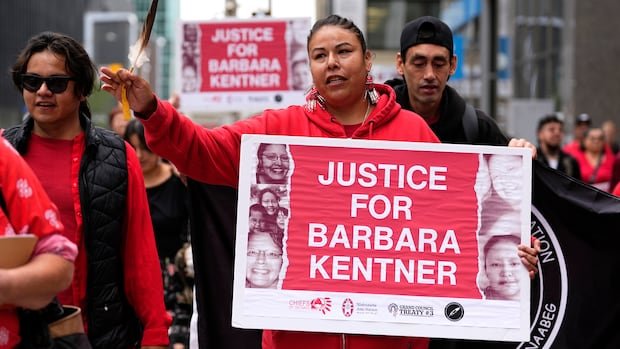

Family and supporters of Barbara Kentner, alongside Indigenous leaders, gathered at Parliament Hill in Ottawa to voice their concerns regarding the recent full parole granted to the individual responsible for the death of the 34-year-old woman from Wabigoon Lake Ojibway Nation. Kentner passed away in 2017 due to medical complications resulting from being struck by a trailer hitch thrown by Brayden Bushby from a moving vehicle.
Bushby, now 27, was granted full parole with conditions on August 13, as confirmed by documents from the Parole Board of Canada (PBC) obtained by CBC News. Speaking to the media before the march in Ottawa, Connie Kentner, Barbara’s sister, emphasized the impact of the parole decision on the family, community, and the broader issue of Indigenous women’s safety.
Despite the PBC’s assertion that Bushby’s release on full parole poses no undue risk and will aid in his reintegration into society as a law-abiding citizen, Connie expressed disappointment in the system’s failure to recognize and respect victims of crime. She highlighted the lack of prior notification to the family by the PBC regarding Bushby’s parole.
The PBC’s decision to grant Bushby full parole followed a history of legal proceedings, including a previous grant of day parole in 2023 which was later revoked in 2024 due to violations of conditions. Subsequently, Bushby received day parole again in December 2025 for six months and was denied full parole, with an extension of his day parole in June 2026.
During the march, a representative of the PBC received a letter from Barbara’s family, emphasizing their ongoing advocacy for justice in her memory. The PBC, in a later statement to CBC News, expressed condolences to the Kentner family while highlighting the privacy constraints preventing direct comments on Bushby’s release.
Indigenous leaders, including representatives from Nishnawbe Aski Nation (NAN) and other organizations, demanded a culturally safe support service for First Nations victims and families navigating the federal corrections and parole system. Grand Chief Francis Kavanaugh of Grand Council Treaty #3 condemned the parole decision, citing systemic racism and the need for justice for Indigenous women, girls, and two-spirit people.
Kavanaugh shared a personal account of his daughter’s experience with racism in Thunder Bay, underscoring the pervasive nature of racism and hatred. The Chiefs of Ontario echoed the call for improved support mechanisms for Indigenous families dealing with the complexities of the justice system.
Connie Kentner reaffirmed her commitment to sharing her sister’s story and seeking justice and accountability. She emphasized Barbara’s humanity and the importance of honoring her memory while continuing the fight for justice.
Support services are available for individuals affected by cases of missing and murdered Indigenous persons, providing immediate emotional assistance and crisis support through national hotlines and mental health counseling resources.