

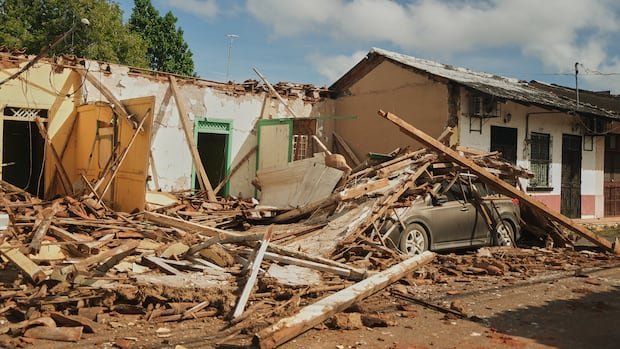

The Panamanian government announced a state of emergency on Saturday following two powerful earthquakes that struck the country, causing significant damage across all 10 provinces and two Indigenous territories. While there were no reported casualties, the earthquakes, measuring 7.7 and 6.6 magnitudes, led to the collapse of buildings near the epicenter and forced evacuations throughout the nation. Over 100 aftershocks were recorded, with magnitudes ranging from 5.2 to 5.8.
The initial earthquake, which was felt in neighboring Colombia, originated approximately 10 kilometers southwest of the remote community of Pitaloza Arriba in Herrera province. The seismic event occurred at a depth of 10 kilometers. In response to the situation, Presidential Minister Juan Carlos Orillac declared the emergency during a press briefing in Panama City, highlighting the significant damage to various infrastructure such as homes, schools, healthcare facilities, roads, and hotels.
According to Malitzie Rivera, the deputy director of the National Civil Protection System, 27 individuals sustained injuries, ranging from minor to moderate. The majority of the destruction was concentrated in the central provinces of Veraguas, Herrera, Cocle, and Los Santos. The Civil Protection agency reported around 420 homes and a similar number of public schools being damaged, along with seven hotels, 13 churches, and nine bridges.
In La Villa de Los Santos, a historic community near the epicenter, several homes and a Catholic church dating back to colonial times collapsed. Displaced residents awaited guidance from authorities on the next steps. The images of collapsed structures and damaged roads heightened concerns in a region already impacted by recent devastating earthquakes.
Despite the extensive destruction, Panama experienced a relatively lower toll compared to previous seismic events in the region, potentially attributed to the country’s strict building codes. These regulations, particularly concerning skyscraper construction in the capital city, may have contributed to minimizing casualties, as noted by Carlos Valdes, the head of the Seismology Department at the National Autonomous University of Mexico.
Officials confirmed the absence of missing persons on Saturday but mentioned that some communities remained isolated due to landslides and road closures. Evacuations were conducted on Isla Cana due to rising sea levels and rough seas, while a shelter in Penonome housed individuals affected by the earthquakes. The water treatment plant in Panama City operated at reduced capacity, and temporary facilities were established at hospitals to accommodate displaced residents.
Tocumen International Airport briefly suspended operations following the earthquakes but later resumed activities. However, numerous travelers faced disruptions, with flights through Panama being canceled or delayed, leaving many stranded in airports across the region. The Panama Canal Authority assured that operations along the vital trade route continued unaffected, with a focus on ensuring the safety of employees, vessels, and crews.
Given Panama’s geographical location along the “Ring of Fire,” seismic activity is common due to the convergence of tectonic plates, including the Cocos, Nazca, and Caribbean plates. The region received an outpouring of support from neighboring countries and international partners following the earthquakes. The U.S. government mobilized disaster response teams, providing expertise in search and rescue operations and allocating $5 million for humanitarian aid. Additionally, U.S. Southern Command delivered food assistance to affected Panamanian communities via helicopters supported by the State Department’s drug-control bureau.