

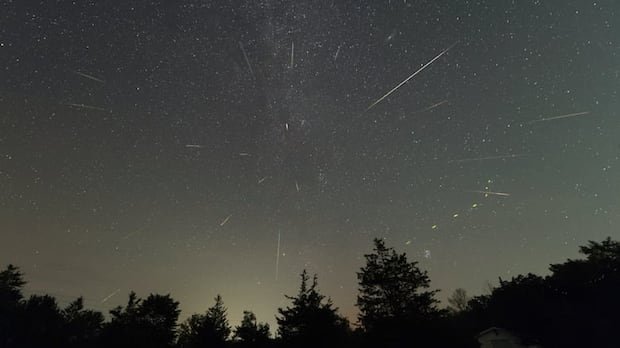

Torontonians may have the chance to witness a meteor shower on Wednesday, provided that weather conditions are favorable. A dazzling display of celestial fireworks is anticipated over Ontario on Wednesday evening through Thursday morning, marking the peak of the Perseid meteor shower. This annual phenomenon showcases vibrant fireballs streaking across the sky, earning recognition as one of the most spectacular meteor showers of the year, as noted by NASA. The space agency forecasts a sighting of approximately 50 to 100 meteors per hour during this event.
Earlier in the day, a partial solar eclipse was expected to be visible in Toronto on Wednesday afternoon from 12:56 p.m. to 2:24 p.m., according to Sky and Telescope, an astronomy magazine. However, the rainy forecast for Toronto on Wednesday might have made it challenging to observe the eclipse. Environment Canada has indicated a possibility of showers with a risk of thunderstorms in the evening, which could also impact the visibility of the meteor shower.
While a total solar eclipse was observable further east over Greenland and Iceland, where the sun was completely obscured for a brief period, the national weather agency suggested the potential development of patches of fog closer to midnight that would dissipate by Thursday morning.
For those who missed the meteor shower on Wednesday, there is still a good chance to catch a glimpse of it on Thursday night, according to Peter Brown, a Canada Research Chair in Meteor Astronomy and a professor at Western University. The Perseid meteor shower, which commenced on July 17, is expected to conclude on August 24, as per NASA’s projections.
To enhance the viewing experience, experts recommend finding a dark location to observe the Perseids. The prime time to witness the meteor shower is between midnight and dawn, with the possibility of spotting meteors as early as 10 p.m. Those situated away from urban lights have a better chance of seeing multiple meteors per minute. Even within the city, a dark park with favorable weather conditions could still allow for the observation of several meteors per hour.
To optimize visibility, experts advise lying back in a lawn chair at a 45-degree angle, choosing the darkest direction for the best results. It is recommended to avoid using electronic devices to allow the eyes to adjust to the darkness. The presence of a new moon on Wednesday will further enhance the viewing experience, creating darker skies for meteor spotting.
During the shower, streaks of light will appear to radiate from the constellation Perseus, from which the meteor shower derives its name, although the meteors are not originated from there. The Perseids are fragments of debris from the 109P/Swift-Tuttle comet, which orbits the sun every 133 years. The next visit of the comet to Earth is not expected until 2125, according to NASA.