

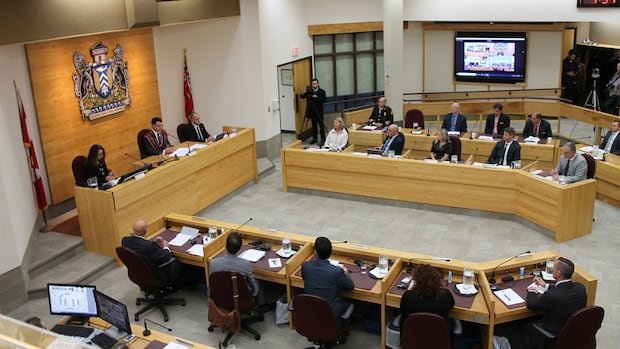

After a 90-minute debate on Monday, city councillors in Sault Ste. Marie rejected a proposal to halt new data center developments in the northern Ontario city. The discussion centered around concerns raised by a local petition opposing a cybersecurity monitoring and training center, including a data center, approved by the city council in December 2025. Spearheaded by cybersecurity company Protexxa and Missanabie Cree First Nation, the project aims to utilize artificial intelligence to address cyber issues for various organizations and governments.
During the council meeting, Ward 3 Coun. Angela Caputo introduced a motion for an interim control bylaw, or a moratorium, to pause new data center proposals until additional policies and protocols could be established. Despite her plea for thoughtful community-driven decision-making, Mayor Matthew Shoemaker and several councillors expressed hesitancy about certain aspects of the proposed moratorium, leading Caputo to withdraw the motion.
It is anticipated that a new motion will be presented at the upcoming meeting on Aug. 31, tasking city staff with crafting a specific municipal framework for data centers in Sault Ste. Marie, with provisions for public input. The outcome of this vote is unlikely to impact the already approved Protexxa data center project on Yates Avenue in the city-owned industrial park, pending the finalization of the property sale.
Emphasizing the need to differentiate between data center types, Mayor Shoemaker cautioned against equating all facilities with large-scale power consumption. While acknowledging the existence of “hyperscale” data centers in North America requiring significant resources, Protexxa assured that their plans would only consume five megawatts, a fraction of the city’s total power capacity. The city’s main electricity utility, PUC, confirmed its ability to accommodate this demand but highlighted the incapacity to support a hyperscale facility.
City officials highlighted existing server room facilities in the Sault similar in size to Protexxa’s proposal, indicating that all data center proposals, irrespective of size, would undergo council scrutiny for rezoning suitability. Mayor Shoemaker argued against a moratorium on future data center proposals, asserting that the city’s decision-making process already includes assessments of infrastructure capacity and environmental considerations. He advocated for process enhancements without undermining the previous decision-making process.
In light of these considerations, the city council opted to explore improvements to the existing framework rather than implementing a blanket moratorium on data center proposals.