

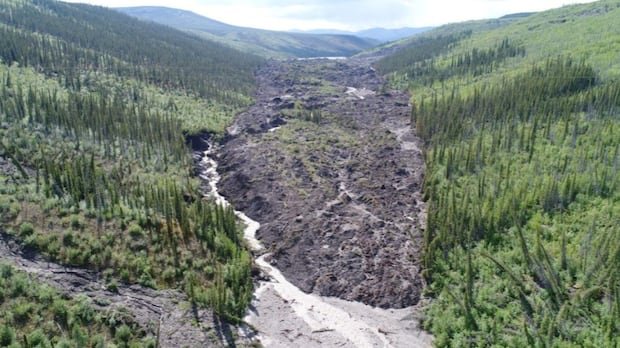

A recent study delved into two significant landslides that occurred nearly ten years ago in the Mackenzie River basin. Known as “permafrost detachment slides,” these events took place on the Johnson River in 2017 and the Redstone River in 2018. Unlike typical permafrost failures that occur gradually from the top down due to warming temperatures and increased precipitation, permafrost detachment slides involve a sudden and rapid failure from the bottom up, occurring about 20 meters below the surface.
Joseph Young, a former University of Alberta PhD student and lead author of a study published in Geophysical Research Letters, explained the unique nature of permafrost detachment slides. These slides can displace vast amounts of material in a matter of days, a process that would normally take decades with standard permafrost failures.
The Redstone River landslide in August 2018 moved approximately 4.5 million cubic meters of ground into the basin, while the Johnson River slide in August 2017 displaced about 18 million cubic meters, equivalent to filling around 7,200 Olympic swimming pools. Eric McLeod, who witnessed the Johnson River slide from the air, observed significant changes in the landscape over subsequent flights in the following years.
The study attributed the triggers of these landslides to wildfires in 1995, which stripped the area of organic material, impacting the top layer of permafrost. This disturbance, compounded by the warming effects of fire and climate change, led to large-scale landslides nearly two decades later. Researchers highlighted that there are warning signs before permafrost detachment slides occur, offering a potential window for prediction and mitigation efforts.