

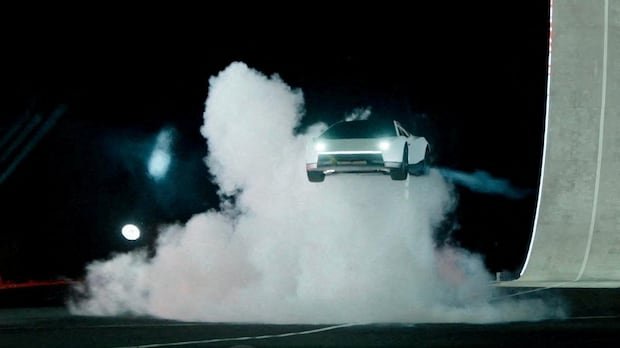

Tesla has introduced a revamped Roadster equipped with rocket-style thrusters, announcing plans to commence production in 2028, over ten years following the initial reveal of its next-gen electric sports car. Developed in partnership with SpaceX, CEO Elon Musk’s rocket firm, the white two-seater vehicle showcased unique capabilities during its unveiling event. It showcased a suction system enabling it to drive upside down on a ramp, perform aerial maneuvers, and utilize built-in thrusters for dynamic movements, including jumping over a truck and other vehicles.
Some observers interpreted the collaboration as a strategic move by Musk to generate interest in a potential merger between his two major enterprises. Tesla’s stock rose by five percent in pre-market trading post the unveiling, presenting the company with a flagship car model after previous Roadster launch delays. However, the timing coincides with Tesla’s strategic shift towards self-driving technology and robotics, just ahead of the crucial third-quarter financial results that hold significant importance for investors.
The Roadster event was lauded as a remarkable engineering display with minimal commercial value, according to Gene Munster, managing partner at Deepwater Asset Management. While Musk downplayed the car’s financial impact on Tesla in the past, it symbolizes a significant milestone for the company. Morningstar analyst Seth Goldstein highlighted the Roadster as a pivotal showcase vehicle for Tesla, filling the gap for a high-performance luxury car in its lineup.
The Roadster reservation page post-event revealed multiple variants with varying deposit requirements, ranging from $50,000 to $250,000 for different configurations. The event, held at a SpaceX test site in Texas, featured typical Musk-style product launch elements, including dramatic presentations and enthusiastic crowd engagement. The Roadster boasts impressive performance metrics, with the ability to accelerate rapidly and reach high speeds, accompanied by a considerable driving range on a single charge.
The unveiling of the second-generation Roadster signifies Tesla’s transition towards AI-driven self-driving technology and robotics, marking a departure from traditional vehicle manufacturing for human drivers. With a renewed focus on cutting-edge technologies and innovative products like humanoid robots and robotaxi services, Tesla remains at the forefront of the evolving automotive landscape. As the company prepares to announce its third-quarter financial results, analysts emphasize the significance of financial metrics and operational performance over product unveilings for investor confidence.