

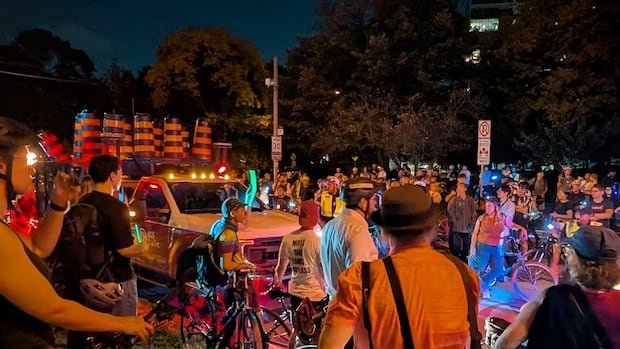

Cyclists in Toronto recently disrupted provincial efforts to remove bike lanes on a section of Bloor Street W. through a protest that began on Tuesday evening and resulted in one arrest. The removal of the bike lane near the intersection of Bloor Street West and Islington Avenue, as part of an Ontario government initiative to eliminate bike lanes on three major Toronto roads, was scheduled to commence on Tuesday evening.
During the protest, cyclists surrounded construction trucks near the intersection, preventing them from moving shortly after 8 p.m. Organizers stated that the demonstration aimed to highlight that removing the lanes would compromise road safety for all users. The protest concluded peacefully when police escorted construction crews away from Bloor Street, with demonstrators chanting “get home safe” to the departing workers.
On Wednesday afternoon, police dispersed a group of cyclists holding a sit-in at the bike lane, leading to at least one demonstrator in a green bike helmet being taken into custody. A worker also removed a bike lane sign nearby. A 25-year-old woman from Hamilton was later arrested in the area and charged with obstructing a police officer and causing mischief to property under $5,000.
Cycle Toronto, represented by Michael Longfield, praised the protesters for their dedication and mentioned the ongoing efforts to delay the construction work. Despite the protest and legal actions taken, Ontario Transportation Minister Prabmeet Sarkaria reaffirmed that the removal of the bike lanes would proceed as planned, emphasizing the provincial government’s commitment to their mandate.
The legal battle over the removal of bike lanes has escalated, with Cycle Toronto seeking leave to appeal to the Supreme Court of Canada. The dispute stems from a 2024 law allowing the province to replace bike lanes with car lanes on major roads, a decision contested for its impact on cyclist safety. Although legal actions are ongoing, immediate removals planned by the province are likely to proceed, with potential implications for future construction work.