

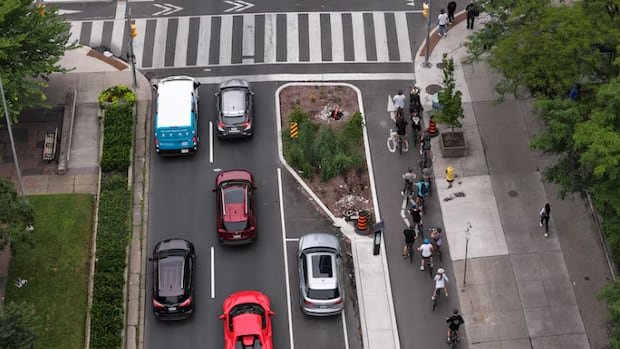

The Ontario transportation ministry has initiated the removal and reconfiguration of bike lanes on several major roads in Toronto. This move has raised concerns about the project’s scope and the financial implications for taxpayers.
The ministry disclosed its plan to restore motor vehicle lanes on Bloor Street, Yonge Street, University Avenue, Queen’s Park, Queen’s Park Crescent, and Avenue Road. Additionally, a request for proposals has been issued to explore design options that could either retain or alter the existing bike lanes.
Margaret Parkhill, an engineer from consulting firm Arup involved in previous bike lane projects in the city, highlighted the complexity of removing or reconfiguring lanes. She emphasized that the costs involved in both adding and removing lanes are likely to be similar, considering the need for road reconstruction, signage adjustments, and modifications to traffic signals and parking infrastructure.
Efforts to obtain projected costs and responsibilities for funding from the city and province are ongoing. The transportation ministry’s spokesperson, Charlotte Carron, reiterated Minister Prabmeet Sarkaria’s stance on the bike lanes during a recent news conference but did not provide specific details on costs or funding allocation.
Although the exact cost of the project remains undisclosed, uncertainties persist regarding who will bear the financial burden. According to Jeff Casello, a transportation planning and engineering expert, city road maintenance typically falls under municipal jurisdiction, while provincial authorities oversee highways, raising questions about cost-sharing arrangements.
Critics, including Myer Siemiatycki from Toronto Metropolitan University, have expressed concerns about the substantial financial implications of the government’s decision to remove bike lanes. Sarkaria defended the move during the news conference, citing the aim to reduce gridlock-associated costs and enhance traffic flow in a bustling city like Toronto.
The process of removing or altering bike lanes involves varying levels of complexity, as explained by Casello. From simple tasks like repainting lanes to more intricate reconstructions that may involve curb modifications, the extent of work required depends on the existing infrastructure.
Parkhill highlighted potential changes at critical intersections, such as Bloor Street and Saint George Street, where adjustments to infrastructure like fire hydrants and streetlights may be necessary. The effectiveness of the project in improving travel times post-construction should be a key consideration, according to Casello, to demonstrate tangible benefits to the public.
The city and province have a history of disagreements over bike lane management, particularly concerning legislative control granted to the province in 2024. The recent court ruling allowing the removal of protected bike lanes in Toronto has set the stage for the current removal and reconfiguration plans announced by the province.
As the project progresses, stakeholders await further details on the implementation of the bike lane removal and reconfiguration initiative and its implications for traffic management in the city.