

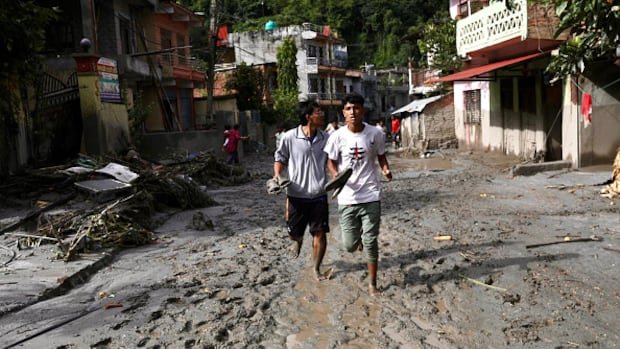

Rescue operations were underway on Thursday to locate hundreds of individuals missing in the aftermath of a devastating flood and mudslide along the Nepal-China border following a glacier collapse. The tragic event resulted in 168 fatalities, left over 1,300 people unaccounted for, and displaced numerous residents in the Himalayan region.
Among the missing individuals were 24 Canadians, according to Bharat Raj Paudyal, Nepal’s ambassador to Canada. The affected area, popular among hikers and pilgrims, witnessed harrowing scenes of people being engulfed by the floodwaters and structures being demolished. Drone footage captured the extensive damage in Nepal.
The challenging terrain of the region, characterized by steep valleys, serves as vital economic routes but becomes perilous during calamities. Buildings in Nuwakot were seen covered in mud, debris entangled in trees, vehicles buried, and survivors coated in mud. The flood disrupted travel in various areas.
The Himalayan mountain range, with its towering peaks and glaciers, spans multiple South Asian countries and faces heightened risks of flooding and landslides due to extreme weather events. The melting glaciers, accelerated by human-induced climate change, have intensified in recent years, leading to increased ice loss rates.
The catastrophe claimed 165 lives in Nepal and left 826 missing, with three fatalities and 558 missing in Tibet. The destruction of bridges and roads hindered search operations, with the Nepalese army conducting helicopter rescues and evacuations.
The Nepal Red Cross Society shifted focus to extensive relief efforts, aiding displaced individuals in flood-affected districts. In Tibet, a mudslide near Gyirong Port buried areas under meters of mud, damaging roads and posing challenges for rescue missions.
Numerous foreigners, including Indian and Australian nationals, were reported missing, with communication disruptions complicating efforts to locate them in the disaster-affected areas. The glacier collapse, initially misidentified as an earthquake, triggered a catastrophic flow of debris downstream, highlighting the vulnerability of communities in the Himalayan region.
The calamity serves as a stark reminder of the precarious situation posed by the unstable Himalayan glaciers, endangering lives, infrastructure, and water resources in the densely populated region.