

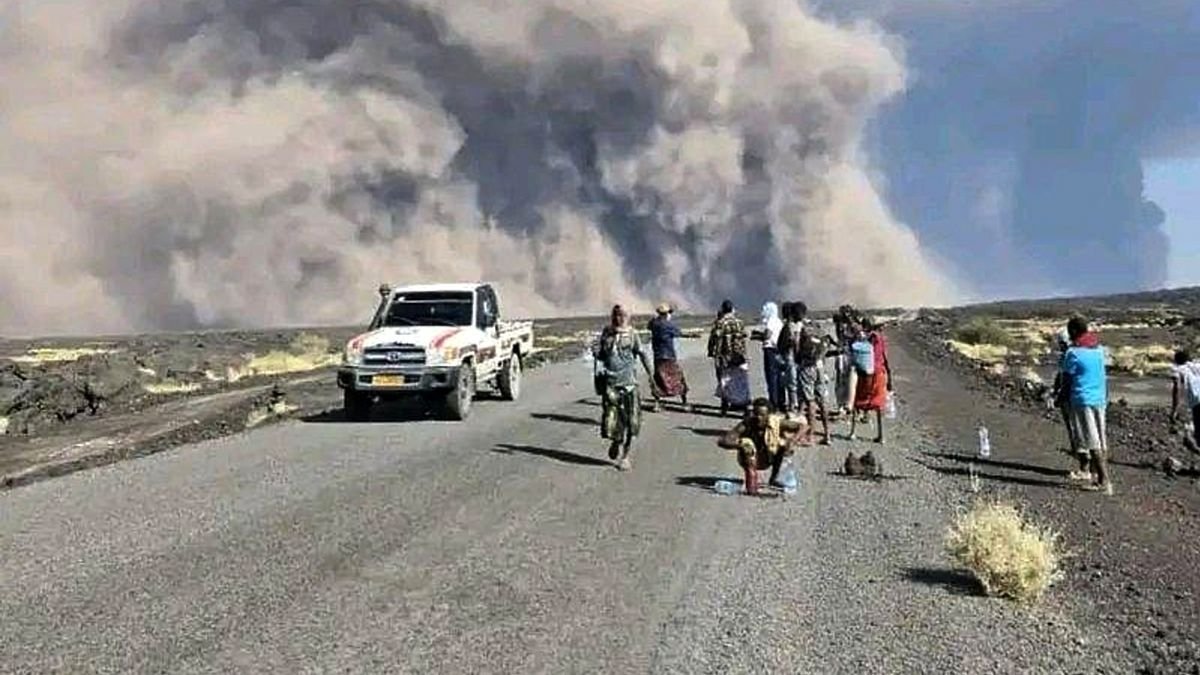

A volcano that had been inactive for approximately 12,000 years has erupted, covering a village in ash and soot. Residents likened the sound of the eruption to an explosion resembling a bomb detonation.
This eruption, the first in modern history for this volcano, named Hayli Gubbi, occurred in Ethiopia’s Afar region near the Eritrean border. The eruption lasted for several hours on a Sunday morning, sending ash clouds into the sky and dusting the nearby village of Afdera. The ash clouds traveled beyond the country’s borders, reaching as far as the Red Sea, Yemen, Oman, and India.
Local resident Ahmed Abdela described the eruption as a sudden bomb-like event, with smoke and ash filling the air. While there have been no reported human or livestock casualties, many villages are covered in ash, leaving little food for their animals.
The eruption has disrupted travel in neighboring countries and continents, leading to flight cancellations by various airlines as a precautionary measure. Ethiopian flights have not been canceled, but several other airlines, including Air India, IndiGo, Akasa, and KLM, have suspended flights due to the ash cloud.
The Director General of the India Meteorological Department, Mrutyunjay Mohapatra, stated that the volcanic ash has affected altitudes between 8.5km and 15km above sea level, potentially impacting satellite functions and flight operations. However, he mentioned that it is unlikely to affect weather conditions or air quality and that the ash is expected to reach northern India before heading towards China.
Skymet Weather, a private agency, highlighted the challenges in measuring the extent of volcanic ash contamination from this eruption due to the lack of preparation time. The agency mentioned that it is uncertain how long it will take for the ash to disperse, but the Indian Meteorological Department predicts that Delhi’s skies will clear from the ash by Tuesday evening.