

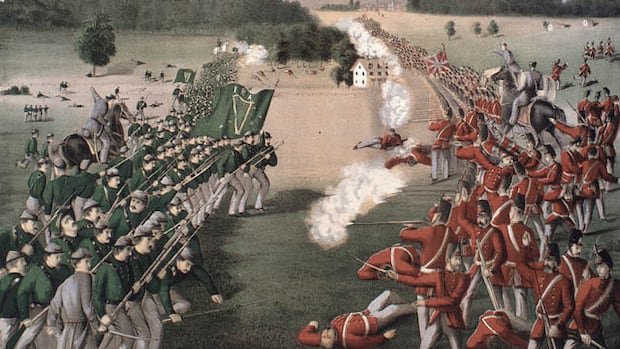

An overlooked clash that occurred on Canadian territory just before Confederation might not hold much significance in the national memory of Canadians beyond Fort Erie, Ontario. However, the Battle of Ridgeway, also known as Limestone Ridge, in 1866 stands out for several historical reasons. It marked the first instance of Canadian troops led by Canadian officers engaging in battle. Additionally, it served as the inspiration for Decoration Day, a precursor to Remembrance Day still observed in some regions annually. Despite these historical connections, the nine individuals who lost their lives in the battle are not included in the Books of Remembrance, a comprehensive collection on Parliament Hill memorializing soldiers who perished in service to Canada.
A fresh petition scheduled for presentation in the House of Commons aims to rectify this omission by advocating for the inclusion of the nine fallen soldiers from the Battle of Ridgeway, along with numerous others who perished in the aftermath of the conflict. Conservative MP Fred Davies, who is spearheading the petition, emphasized the importance of Canada acknowledging those who made the ultimate sacrifice in defense of the nation. Representing the Niagara South riding, which encompasses Fort Erie where the battle occurred, Davies expressed a personal connection to the site, underscoring the need for national recognition of this pivotal event.
The Battle of Ridgeway unfolded as a challenging chapter for Canadian forces, pitting inexperienced volunteers against battle-hardened Fenian raiders, many of whom were veterans of the American Civil War. The Fenian Brotherhood, an Irish American movement advocating for Irish independence, sought to achieve their objective by invading and occupying parts of British North America. In 1866, a significant number of raiders crossed the Niagara River with intentions to target the Welland Canal, encountering approximately 800 Canadian volunteers from various regiments at Limestone Ridge near Ridgeway and Fort Erie.
Historian Peter Vronsky, author of the book “Ridgeway: The American Fenian Invasion And The 1866 Battle That Made Canada,” commended the swift mobilization of Canadian forces from the Golden Horseshoe region. However, he noted that the troops were ill-equipped for what he described as Canada’s first modern battle, lacking basic provisions such as food, water, and proper footwear. Despite engaging the invaders in combat, the Canadian forces eventually dispersed in a disorderly retreat following a Fenian bayonet charge. Nevertheless, the Fenians abandoned their incursion post-battle, retreating back to the U.S. side of the Niagara River.
While the Battle of Ridgeway resulted in a military setback, Davies emphasized that the sacrifices made by the fallen soldiers should not be diminished by this outcome. He highlighted their valor in defending Canada against external threats, regardless of the challenges they faced in terms of organization and preparation. Reflecting on the battle’s significance, Davies stressed the importance of honoring those who gave their lives for their country.
Despite occurring prior to the formal establishment of Canada, the Battle of Ridgeway holds a place in the nation’s collective memory. Efforts to include the names of the fallen soldiers in the Books of Remembrance have been ongoing, with Fort Erie Mayor Wayne Redekop advocating for recognition of their contribution to shaping Canada’s identity. The battle’s impact on the road to Confederation was acknowledged by Vronsky, who highlighted its role in uniting Canadians and fostering a sense of national identity.
Several regiments that participated in the 1866 battle, such as the Queen’s Own Rifles and the Royal Hamilton Light Infantry, continue to exist today, symbolizing the legacy of Canada’s modern armed forces. Notable figures like Alexander Muir, who wrote “The Maple Leaf Forever” after fighting at Ridgeway, further underscore the battle’s enduring influence on Canadian culture and patriotism. As Vronsky suggested, the Battle of Ridgeway marked a turning point where Canadians fought not only for the crown but also for their maple leaf emblem, reflecting a growing sense of national pride and identity.