

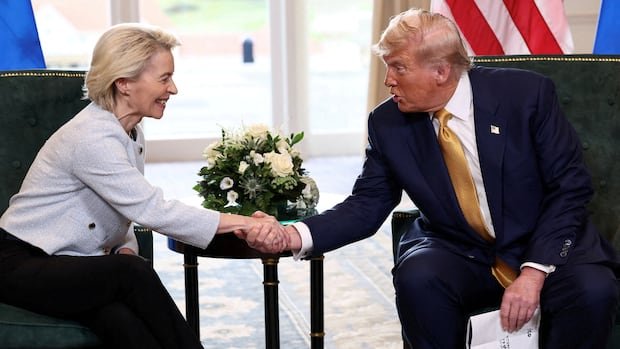

European Union President Ursula von der Leyen made assurances to Europeans at Donald Trump’s Turnberry golf resort in Scotland last year, pledging that agreeing to a blanket 15% U.S. tariff on EU exports would bring the continent “predictability and stability.” However, some critics now view the trade agreement as a one-sided surrender that has led to a continuous cycle of American economic pressure.
Following the Turnberry deal, the U.S. moved to reclassify certain European industrial goods for higher tariffs, sparking a new dispute over Europe’s digital services tax on U.S. tech giants. This conflict mirrors Washington’s recent efforts to dictate tax terms to Ottawa.
Subsequently, Trump threatened to impose 100% tariffs on any European nation implementing or expanding tech taxes, overshadowing the ratified Turnberry deal. In response, European lawmakers are increasingly adopting a resolute stance against Trump’s demands, taking inspiration from Mark Carney’s departure from the U.S. trade negotiations as a lesson in confronting bullies.
Former French ambassador Gerard Araud suggested that Canada’s firm approach with Trump should guide the EU’s actions. German parliamentarian Bernd Lange emphasized the importance of democratic countries uniting against coercion in trade matters, standing in solidarity with Canada.
While the EU and the UK initially sought trade stability with Trump, the outcomes have fallen short of expectations. Both regions now face challenges such as increased tariffs and pressure on digital services taxes. The UK, in particular, faced threats of hefty tariffs over its tech tax, prompting a reconsideration of its stance.
Experts caution that replicating Canada’s approach may be challenging due to differences in public trade sophistication and economic resilience. While Europe and the UK may face obstacles in emulating Canada’s strategy, the possibility of revisiting and renegotiating trade agreements remains open, despite current tensions and uncertainties.
Overall, Europe, the UK, and Canada continue to navigate complex trade dynamics amid shifting political landscapes and wavering confidence in U.S. leadership. Despite setbacks, the potential for future trade negotiations to evolve and succeed remains a possibility, emphasizing the unpredictable nature of trade relations in a globalized economy.