

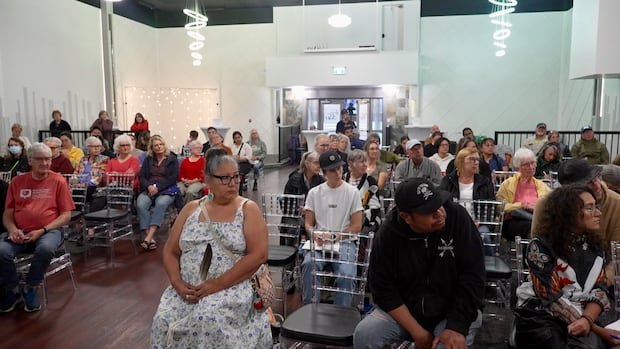

Dozens of individuals in Sault Ste. Marie, Ontario, had the opportunity to voice their opinions on the establishment of large-scale artificial intelligence data centers on Wednesday evening. The event was organized by two city council members, Angela Caputo, who is running for re-election in the upcoming municipal election, and Lisa Vezeau-Allen, who will not be seeking re-election. Noteworthy speakers at the event included the chiefs of neighboring Garden River First Nation and Batchewana First Nation.
Participants at the gathering shared their perspectives on existing and potential data center projects in and around Sault Ste. Marie, with many expressing concerns about potential environmental impacts, noise pollution, and water consumption issues. Notably, there were no representatives from data center projects or subject-matter experts present at the event.
Caputo emphasized her respect for job creation and technological sector growth while underscoring her unwavering commitment to environmental preservation and safeguarding the future for the next generation. The event unfolded following a recent city council meeting where Caputo withdrew a motion to impose a moratorium on large-scale AI data center proposals, as some council members argued that existing protocols were sufficient.
It is anticipated that a new motion will be introduced at the upcoming August 31 meeting, directing city staff to formulate a specific municipal framework for data centers in the city, with provisions for public engagement. Interestingly, the event coincided with the revelation of a new data center proposal in the Algoma region, involving a 400-megawatt facility planned by Red Jar Energy Partners and Algoma Steel, based in Oakville.
Both Red Jar and Algoma Steel have confirmed that the proposal is currently under review by the Independent Electricity System Operator (IESO). The stakeholders intend to engage with the city, Indigenous communities, and other stakeholders to address concerns and incorporate feedback as the project progresses. City officials expect both provincial and municipal involvement in the project’s development.
In a separate development, city councillors were informed that the city lacks the capacity to support a hyperscale data center presently. The existing main electricity utility in Sault Ste. Marie, PUC, manages 120 megawatts of power consumption. Furthermore, a smaller five-megawatt data center project was approved last December, in collaboration with the Missanabie Cree First Nation, aimed at establishing a cybersecurity monitoring and training facility in the city’s industrial park.
A local resident, Ted Johnston, expressed strong opposition to AI data centers during the event, describing them as detrimental to the environment, community residents, and wildlife. He questioned the job creation potential of these facilities and criticized their impact on creativity and employment opportunities. Garden River First Nation Chief Karen Bell emphasized the importance of involving Indigenous communities in data center projects from the outset to ensure meaningful engagement and uphold principles of reconciliation.