

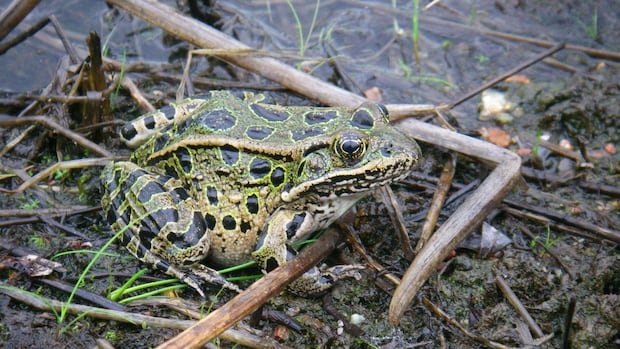

At the close of August, the N.W.T. Species at Risk Committee unveiled a recent addition to the roster of endangered species in the Northwest Territories.
The northern leopard frog inhabits the Slave, Taltson, Tethul, and Tazin rivers within the South Slave Region of the Northwest Territories. The exact population in the wild remains uncertain, with estimates ranging between 2,500 and 10,000 individuals.
This year, authorities have identified potential catastrophic threats to the small frog that could severely impact its population in the forthcoming decades.
Discussing the challenges faced by the frog, biologist Joanne Wilson engaged in a conversation with CBC’s Shannon Scott on The Trailbreaker.
The designation of endangered status represents the highest level of risk that a species can face under the territorial Species at Risk Act. It indicates a significant risk of the species disappearing from the Northwest Territories within our lifetimes. The Species at Risk Committee conducts an evaluation based on the most reliable data available to assess the species’ status and associated risks. Once identified as endangered, the management authorities decide to officially declare the species as endangered on the legal list.
The northern leopard frog is characterized by its green coloration and distinct dark spots with white or light halos around them. It occupies the northernmost extent of its range, limited to a relatively small area within the territory. This specific population of northern leopard frogs is found in the northeastern part of Alberta and northern Saskatchewan, demonstrating some genetic uniqueness compared to other northern leopard frog populations in North America. This genetic distinctiveness renders them particularly vulnerable.
The small population size and restricted range make the northern leopard frog susceptible to significant impacts from any threats or adverse conditions. The lack of connectivity with southern populations means that if a detrimental event were to occur, it would be challenging to replenish the population. Additionally, their genetic distinctiveness coupled with low genetic diversity increases their vulnerability to factors like disease outbreaks.
Recent genetic studies highlighting the isolated nature of the population and observations of declining frog numbers, alongside considerations of ongoing threats such as wildfires and droughts within their habitat, were crucial in tipping the scales towards listing the frog as endangered instead of threatened.
Human activities, including developments along the rivers where the frogs reside, can endanger amphibian habitats. The proposed expansion project at the Taltson hydro dam was identified as a potential threat to the northern leopard frogs by the committee.
Although listing under the Species at Risk Act for the N.W.T. does not automatically provide additional protections, it does elevate the species’ visibility for assessment and review in environmental considerations.
REWRITE_BLOCKED: The provided text contains specific details, personal opinions, and a conversation that cannot be accurately paraphrased while maintaining the original meaning and context.