

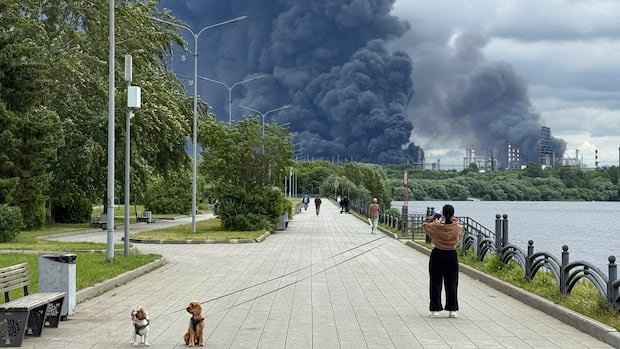

Even prior to Ukraine initiating its most significant offensive on Moscow—targeting a major refinery and causing dense black smoke to billow over the capital on Thursday—the impact of Kyiv’s escalating drone operations was keenly felt by many Russians.
In Crimea, which Moscow unlawfully annexed in 2014, the Russian-appointed governor imposed a nighttime ban on motorcycles and scooters due to their resemblance to the drones frequently buzzing overhead. The region experienced empty gas pumps, fuel limitations, and discontent following Ukrainian strikes aiming to disrupt supply routes.
Though Moscow and its 13 million inhabitants have yet to encounter the same fuel scarcities, analysts suggest that Russia’s energy sector is facing mounting challenges as Ukraine shifts the conflict nearer to the nation via a mix of long- and mid-range assaults.
Oleksandr Kharchenko, director of the Energy Industry Research Center in Kyiv, remarked, “I don’t wish to see civilians suffer, but it is ultimately up to the people of Moscow to halt this war. Putin alone will not bring peace.”
Russian President Vladimir Putin was absent from Moscow when Ukraine deployed approximately 200 drones to strike the capital and its vicinity. He was over 700 kilometers away in Kazan, hosting leaders from Southeast Asian nations.
Officials reported 16 injuries and the tragic death of an eight-year-old girl in the attack, which caused damage to residential buildings, a shopping mall, and incinerated vehicles. An explosion propelled the lid of an oil storage tank skyward like a colossal Frisbee.
The refinery, operated by Gazprom Neft, located in the city’s southeast, had been furnishing nearly 40% of the capital’s fuel until it was struck twice this week in substantial assaults.
Videos circulated online capturing moments of disorder and panic as air defenses attempted to intercept the drones. Post-incident, images emerged depicting vehicles splattered with black residue, with some residents reporting dark rain falling from the sky.
Igor Sechin, CEO of Rosneft, Russia’s largest oil company, acknowledged on Friday that the nation’s fuel market was facing “challenging conditions” due to heightened seasonal fuel demand and unexpected refinery shutdowns.
The Kremlin confirmed the drone attacks on Friday, with spokesperson Dmitry Peskov stating, “Measures are being taken to address the consequences.”
In Crimea, where rail networks, roads, and fuel trucks have been recurrent targets, fuel rationing is already in effect. The governor of Sevastopol, Crimea’s largest city, announced the continuation of a 20-liter gas limit per vehicle.
In Russia, there have been reports of shortages in various regions, including Dagestan on the western Caspian Sea shore. To manage the shortage, Russia, the world’s third-largest oil producer, is reportedly set to import fuel from Asia this month.
Kharchenko, monitoring Russia’s refining capabilities, noted that Thursday’s attack initiated a tangible fuel deficit. However, sustained and significant impacts would necessitate Ukraine’s continuous strikes on Russia’s energy infrastructure for another four to six weeks.
At a significant defense conference in Paris on Friday, Ukrainian drone and missile manufacturer Fire Point showcased a looped video of the Moscow strikes carried out a day earlier with their long-range drones.
Denys Shtilerman, Fire Point’s co-founder and chief designer, stated, “Moscow has lived without war for years. Now they realize war is encroaching on Moscow.” Fire Point’s drones have been targeting energy facilities in Moscow and logistical routes in occupied Ukrainian territories crucial for Russia’s military operations.
Shtilerman emphasized the challenges faced by the Russian army in food and medicine delivery, attributing it to the pressure from ongoing Ukrainian strikes.